Advertisements
Advertisements
Question
Find the Direction Cosines of the Sides of the triangle Whose Vertices Are (3, 5, -4), (-1, 1, 2) and (-5, -5, -2).
Advertisements
Solution
Let A(3, 5,−4), B(−1, 1, 2) and C(−5, −5, −2).
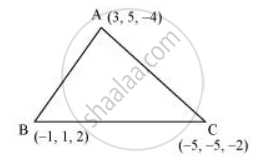
Direction ratio of AB = (−1 − 3), (1 − 5), (2 − (−4))
= (−4, −4, 6)
|AB| = `sqrt((-4)^2 + (-4)^2 + (6)^2)`
= `sqrt(16 + 16 + 36)`
= `sqrt68`
= `2sqrt17`
Direction ratio of BC = (−5 − (−1), −5 − 1, −2 − 2)
= (−4, −6, −4)
|BC| = `sqrt((-4)^2 + (-6)^2 + (-4)^2)`
= `sqrt(16 + 36 + 16)`
= `sqrt68`
= `2sqrt17`
Direction ratio of CA = (−5 − 3, −5 − 5, −2 − (−4))
= (−8, −10, 2)
|CA| = `sqrt((-8)^2 + (-10)^2 + (2)^2)`
= `sqrt(64 + 100 + 4)`
= `sqrt168`
= `2sqrt42`
∴ AB are `< (-1 - 3)/|AB|, (1 - 5)/|AB|, (2 + 4)/|AB| >`
i.e., `< (-2)/sqrt17, (-2)/sqrt17, 3/sqrt17 >`
∴ d.c. of BC are `< (-5 + 1)/|BC|, (- 5 - 1)/|BC|, (- 2 -2)/|BC|>`
i.e., `< (-2)/sqrt17, (-3)/sqrt17, (-2)/sqrt17 >`
∴ d.c of CA are `< (3 + 5)/|CA|, (5 + 5)/|CA|, (- 4 + 2)/|CA|`
i.e., `< 4/sqrt42, 5/sqrt42, (-1)/sqrt42 >`
APPEARS IN
RELATED QUESTIONS
Direction cosines of the line passing through the points A (- 4, 2, 3) and B (1, 3, -2) are.........
Write the direction ratios of the following line :
`x = −3, (y−4)/3 =( 2 −z)/1`
If l, m, n are the direction cosines of a line, then prove that l2 + m2 + n2 = 1. Hence find the
direction angle of the line with the X axis which makes direction angles of 135° and 45° with Y and Z axes respectively.
If a line makes angles 90°, 135°, 45° with the X, Y, and Z axes respectively, then its direction cosines are _______.
(A) `0,1/sqrt2,-1/sqrt2`
(B) `0,-1/sqrt2,-1/sqrt2`
(C) `1,1/sqrt2,1/sqrt2`
(D) `0,-1/sqrt2,1/sqrt2`
If l1, m1, n1 and l2, m2, n2 are the direction cosines of two mutually perpendicular lines, show that the direction cosines of the line perpendicular to both of these are m1n2 − m2n1, n1l2 − n2l1, l1m2 − l2m1.
If the lines `(x-1)/(-3) = (y -2)/(2k) = (z-3)/2 and (x-1)/(3k) = (y-1)/1 = (z -6)/(-5)` are perpendicular, find the value of k.
Find the angle between the vectors with direction ratios proportional to 1, −2, 1 and 4, 3, 2.
Show that the points (2, 3, 4), (−1, −2, 1), (5, 8, 7) are collinear.
Find the angle between the lines whose direction ratios are proportional to a, b, c and b − c, c − a, a− b.
Write the angle between the lines whose direction ratios are proportional to 1, −2, 1 and 4, 3, 2.
Find the distance of the point (2, 3, 4) from the x-axis.
If a unit vector `vec a` makes an angle \[\frac{\pi}{3} \text{ with } \hat{i} , \frac{\pi}{4} \text{ with } \hat{j}\] and an acute angle θ with \[\hat{ k} \] ,then find the value of θ.
Find the vector equation of a line passing through the point (2, 3, 2) and parallel to the line `vec("r") = (-2hat"i"+3hat"j") +lambda(2hat"i"-3hat"j"+6hat"k").`Also, find the distance between these two lines.
Verify whether the following ratios are direction cosines of some vector or not
`1/sqrt(2), 1/2, 1/2`
Find the direction cosines of a vector whose direction ratios are
1, 2, 3
Find the direction cosines of a vector whose direction ratios are
`1/sqrt(2), 1/2, 1/2`
Find the direction cosines and direction ratios for the following vector
`3hat"i" + hat"j" + hat"k"`
Find the direction cosines and direction ratios for the following vector
`5hat"i" - 3hat"j" - 48hat"k"`
Find the direction cosines and direction ratios for the following vector
`3hat"i" - 3hat"k" + 4hat"j"`
If `1/2, 1/sqrt(2), "a"` are the direction cosines of some vector, then find a
If `vec"a" = 2hat"i" + 3hat"j" - 4hat"k", vec"b" = 3hat"i" - 4hat"j" - 5hat"k"`, and `vec"c" = -3hat"i" + 2hat"j" + 3hat"k"`, find the magnitude and direction cosines of `vec"a", vec"b", vec"c"`
If α, β, γ are the angles that a line makes with the positive direction of x, y, z axis, respectively, then the direction cosines of the line are ______.
If a line makes angles `pi/2, 3/4 pi` and `pi/4` with x, y, z axis, respectively, then its direction cosines are ______.
O is the origin and A is (a, b, c). Find the direction cosines of the line OA and the equation of plane through A at right angle to OA.
If the directions cosines of a line are k,k,k, then ______.
The area of the quadrilateral ABCD, where A(0,4,1), B(2, 3, –1), C(4, 5, 0) and D(2, 6, 2), is equal to ______.
The line `vec"r" = 2hat"i" - 3hat"j" - hat"k" + lambda(hat"i" - hat"j" + 2hat"k")` lies in the plane `vec"r".(3hat"i" + hat"j" - hat"k") + 2` = 0.
Find the direction cosine of a line which makes equal angle with coordinate axes.
A line passes through the points (6, –7, –1) and (2, –3, 1). The direction cosines of the line so directed that the angle made by it with positive direction of x-axis is acute, are ______.
Equation of line passing through origin and making 30°, 60° and 90° with x, y, z axes respectively, is ______.
If \[\alpha\], \[\beta\], and \[\gamma\] are the direction angles of a line, which ordered triple gives its direction cosines?
Which identity must be satisfied by the direction cosines \[(l,m,n)\] of a line?
Any three numbers proportional to the direction cosines of a line are called its:
Which proportion correctly expresses the relationship between direction ratios \[(a,b,c)\] and direction cosines \[(l,m,n)\]?
For the line directed from \[P(x_1,y_1,z_1)\] to \[Q(x_2,y_2,z_2)\], which expression is the direction cosine \[m\]?
