Advertisements
Advertisements
Question
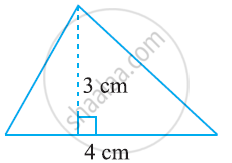
Find the area of the following triangle:
Advertisements
Solution
Area of triangle = `1/2 xx "Base" xx "Height" `
Base = 4 cm
Height = 3 cm
Area = `1/2 xx 4 xx 3`
= `12/2`
= 6 cm2
RELATED QUESTIONS
If the points A(−2, 1), B(a, b) and C(4, −1) are collinear and a − b = 1, find the values of a and b.
If A(−4, 8), B(−3, −4), C(0, −5) and D(5, 6) are the vertices of a quadrilateral ABCD, find its area.
The vertices of a ΔABC are A (4, 6), B (1, 5) and C (7, 2). A line is drawn to intersect sides AB and AC at D and E respectively, such that `(AD)/(AB) = (AE)/(AC) = 1/4`Calculate the area of the ΔADE and compare it with the area of ΔABC. (Recall Converse of basic proportionality theorem and Theorem 6.6 related to ratio of areas of two similar triangles)
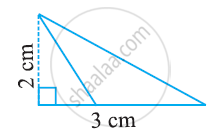
Find the area of the following triangle:
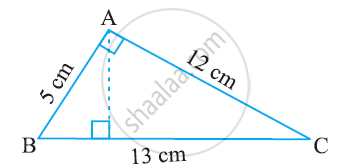
ΔABC is right angled at A (see the given figure). AD is perpendicular to BC. If AB = 5 cm, BC = 13 cm and AC = 12 cm, Find the area of ΔABC. Also find the length of AD.
Find a relation between x and y, if the points A(2, 1), B(x, y) and C(7,5) are collinear.
If the area of triangle ABC formed by A(x, y), B(1, 2) and C(2, 1) is 6 square units, then prove that x + y = 15 ?
In ∆PQR, PR = 8 cm, QR = 4 cm and PL = 5 cm. 
Find:
(i) the area of the ∆PQR
(ii) QM.
The points (1,1), (-2, 7) and (3, -3) are ______.
Points A(3, 1), B(12, –2) and C(0, 2) cannot be the vertices of a triangle.
