Advertisements
Advertisements
Question
Find the magnetic field B at the centre of a rectangular loop of length l and width b, carrying a current i.
Advertisements
Solution
Let the angles made by points A and B with point O be \[\theta_1 \text{ and } \theta_2\] , respectively.
And ,

\[\text{ AO }= \sqrt{\left( \frac{b}{2} \right)^2 + \left( \frac{l}{2} \right)^2} = \frac{1}{2}\sqrt{b^2 + l^2}\]
\[B = \frac{\mu_0 i}{4\pi d}(\sin \theta_1 + \sin \theta_2 )\]
\[ \Rightarrow B = \frac{\mu_0 i}{4\pi d} \times 2\sin \theta \]
\[\Rightarrow B = \frac{\mu_0 i}{4\pi\left( \frac{b}{2} \right)} \times \frac{2l}{\sqrt{l^2 + b^2}}\]
\[ = \frac{\mu_0 i}{\pi b}\frac{l}{\sqrt{l^2 + b^2}}\]
Similarly, the magnetic field due to current in wire BC is given by
Magnetic field due to current in wire CD = Magnetic field due to current in wire AB = B
And,
Magnetic field due to current in wire DA = Magnetic field due to current in wire BC = B'
\[ = 2\left[ \frac{\mu_0 i}{\pi b}\frac{l}{\sqrt{l^2 + b^2}} + \frac{\mu_0 i}{\pi l}\frac{b}{\sqrt{l^2 + b^2}} \right]\]
\[ = \frac{2 \mu_0 i}{\pi\sqrt{l^2 + b^2}}\left[ \frac{l}{b} + \frac{b}{l} \right]\]
\[ = \frac{2 \mu_0 i\sqrt{b^2 + l^2}}{\pi bl}\]
APPEARS IN
RELATED QUESTIONS
In a chamber, a uniform magnetic field of 6.5 G (1 G = 10–4 T) is maintained. An electron is shot into the field with a speed of 4.8 × 10⁶ m s−1 normal to the field. Explain why the path of the electron is a circle. Determine the radius of the circular orbit.
(e = 1.5 × 10⁻¹⁹ C, me = 9.1 × 10⁻³¹ kg)
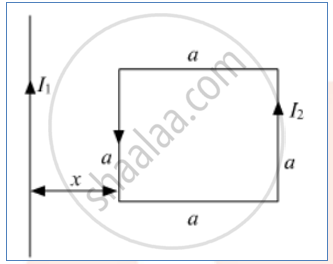
A square loop of side 'a' carrying a current I2 is kept at distance x from an infinitely long straight wire carrying a current I1 as shown in the figure. Obtain the expression for the resultant force acting on the loop.
A planar loop of rectangular shape is moved within the region of a uniform magnetic field acting perpendicular to its plane. What is the direction and magnitude of the current induced in it?
A uniform magnetic field of 3000 G is established along the positive z-direction. A rectangular loop of sides 10 cm and 5 cm carries a current of 12 A. What is the torque on the loop in the different cases shown in fig.? What is the force on each case? Which case corresponds to stable equilibrium?

A vector quantity that measures the strength and orientation of a current loop as a magnetic source is called the:
The magnetic dipole moment of a coil of N turns, carrying current I and enclosing area A, is:
In a rectangular loop ABCD placed in a uniform magnetic field \[\vec{B}\], the sides AB and CD are parallel to \[\vec{B}\]. The force on each of these sides is:
For a rectangular loop whose plane is parallel to \[\vec{B}\] (θ = 90°), the torque is computed as force × perpendicular distance between the two forces, which gives:
The torque on a current-carrying loop in a uniform magnetic field is maximum when:
The vector form of the torque on a magnetic dipole in a uniform magnetic field is:
A circular coil of 100 turns and radius 10 cm carries a current of 3.2 A. The magnetic field at the centre of the coil is:
