Advertisements
Advertisements
प्रश्न
Find the magnetic field B at the centre of a rectangular loop of length l and width b, carrying a current i.
Advertisements
उत्तर
Let the angles made by points A and B with point O be \[\theta_1 \text{ and } \theta_2\] , respectively.
And ,

\[\text{ AO }= \sqrt{\left( \frac{b}{2} \right)^2 + \left( \frac{l}{2} \right)^2} = \frac{1}{2}\sqrt{b^2 + l^2}\]
\[B = \frac{\mu_0 i}{4\pi d}(\sin \theta_1 + \sin \theta_2 )\]
\[ \Rightarrow B = \frac{\mu_0 i}{4\pi d} \times 2\sin \theta \]
\[\Rightarrow B = \frac{\mu_0 i}{4\pi\left( \frac{b}{2} \right)} \times \frac{2l}{\sqrt{l^2 + b^2}}\]
\[ = \frac{\mu_0 i}{\pi b}\frac{l}{\sqrt{l^2 + b^2}}\]
Similarly, the magnetic field due to current in wire BC is given by
Magnetic field due to current in wire CD = Magnetic field due to current in wire AB = B
And,
Magnetic field due to current in wire DA = Magnetic field due to current in wire BC = B'
\[ = 2\left[ \frac{\mu_0 i}{\pi b}\frac{l}{\sqrt{l^2 + b^2}} + \frac{\mu_0 i}{\pi l}\frac{b}{\sqrt{l^2 + b^2}} \right]\]
\[ = \frac{2 \mu_0 i}{\pi\sqrt{l^2 + b^2}}\left[ \frac{l}{b} + \frac{b}{l} \right]\]
\[ = \frac{2 \mu_0 i\sqrt{b^2 + l^2}}{\pi bl}\]
APPEARS IN
संबंधित प्रश्न
A square coil of side 10 cm consists of 20 turns and carries a current of 12 A. The coil is suspended vertically and the normal to the plane of the coil makes an angle of 30° with the direction of a uniform horizontal magnetic field of magnitude 0.80 T. What is the magnitude of torque experienced by the coil?
In a chamber, a uniform magnetic field of 6.5 G (1 G = 10–4 T) is maintained. An electron is shot into the field with a speed of 4.8 × 10⁶ m s−1 normal to the field. Explain why the path of the electron is a circle. Determine the radius of the circular orbit.
(e = 1.5 × 10⁻¹⁹ C, me = 9.1 × 10⁻³¹ kg)
A rectangular loop of wire of size 4 cm × 10 cm carries a steady current of 2 A. A straight long wire carrying 5 A current is kept near the loop as shown. If the loop and the wire are coplanar, find
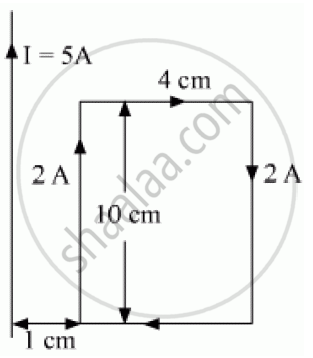
(i) the torque acting on the loop and
(ii) the magnitude and direction of the force on the loop due to the current carrying wire.
A magnetised needle of magnetic moment 4.8 × 10⁻² JT−1 is placed at 30° with the direction of uniform magnetic field of magnitude 3 × 10⁻² T. Calculate the torque acting on the needle.
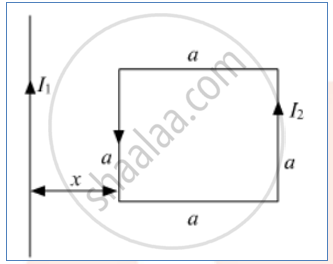
A square loop of side 'a' carrying a current I2 is kept at distance x from an infinitely long straight wire carrying a current I1 as shown in the figure. Obtain the expression for the resultant force acting on the loop.
A uniform magnetic field of 3000 G is established along the positive z-direction. A rectangular loop of sides 10 cm and 5 cm carries a current of 12 A. What is the torque on the loop in the different cases shown in fig.? What is the force on each case? Which case corresponds to stable equilibrium?

A rectangular conducting loop consists of two wires on two opposite sides of length l joined together by rods of length d. The wires are each of the same material but with cross-sections differing by a factor of 2. The thicker wire has a resistance R and the rods are of low resistance, which in turn are connected to a constant voltage source V0. The loop is placed in uniform a magnetic field B at 45° to its plane. Find τ, the torque exerted by the magnetic field on the loop about an axis through the centres of rods.
- Assertion (A): The deflecting torque acting on a current-carrying loop is zero when its plane is perpendicular to the direction of the magnetic field.
- Reason (R): The deflecting torque acting on a loop of the magnetic moment `vecm` in a magnetic field `vecB` is given by the dot product of `vecm` and `vecB`.
When a current-carrying loop is placed in a uniform magnetic field, what does it experience?
The rotational effect experienced by a current-carrying loop placed in a uniform magnetic field is called:
In a rectangular loop ABCD placed in a uniform magnetic field \[\vec{B}\], the sides AB and CD are parallel to \[\vec{B}\]. The force on each of these sides is:
In a rectangular loop in a uniform magnetic field, the sides BC and AD are perpendicular to \[\vec{B}\]. The magnitude of the force on each of these sides is:
For a rectangular loop whose plane is parallel to \[\vec{B}\] (θ = 90°), the torque is computed as force × perpendicular distance between the two forces, which gives:
The torque on a current-carrying loop in a uniform magnetic field is maximum when:
The vector form of the torque on a magnetic dipole in a uniform magnetic field is:
A circular coil of 100 turns and radius 10 cm carries a current of 3.2 A. The magnetic field at the centre of the coil is:
