English

Find the General Solution of the Differential Equation Dybydx -y = Sin X - Mathematics

Advertisements
Advertisements

Question

Find the general solution of the differential equation `dy/dx - y = sin x`

Advertisements

Solution

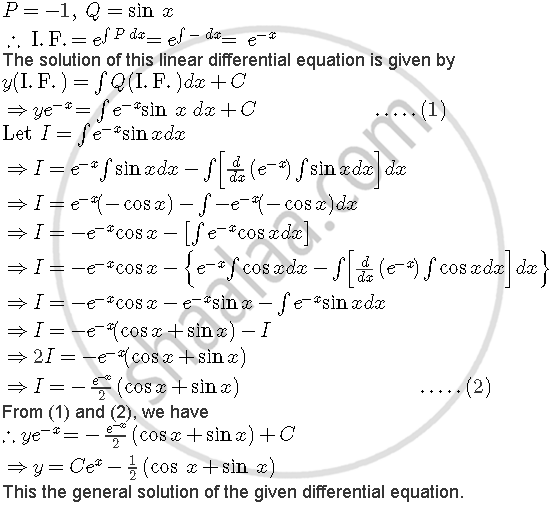
The given differential equation is

`dy/dx - y = sin x` .....(1)

Clearly, it is a linear differential equation of the form `dy/dx + Py=Q`

Here
shaalaa.com
  Is there an error in this question or solution?
2016-2017 (March) All India Set 3

RELATED QUESTIONS

For the differential equation, find the general solution:

`dy/dx  + 2y = sin x`


For the differential equation, find the general solution:

(1 + x2) dy + 2xy dx = cot x dx (x ≠ 0)


For the differential equation, find the general solution:

`x dy/dx + y - x + xy cot x = 0(x != 0)`


For the differential equation, find the general solution:

y dx + (x – y2) dy = 0


Find the equation of the curve passing through the origin given that the slope of the tangent to the curve at any point (x, y) is equal to the sum of the coordinates of the point.


Find the equation of a curve passing through the point (0, 2) given that the sum of the coordinates of any point on the curve exceeds the magnitude of the slope of the tangent to the curve at that point by 5.


The integrating factor of the differential equation.

`(1 - y^2) dx/dy + yx = ay(-1 < y < 1)` is ______.


\[\left( 2x - 10 y^3 \right)\frac{dy}{dx} + y = 0\]

dx + xdy = e−y sec2 y dy


Find the general solution of the differential equation \[\frac{dy}{dx} - y = \cos x\]


Find the particular solution of the differential equation \[\frac{dx}{dy} + x \cot y = 2y + y^2 \cot y, y ≠ 0\] given that x = 0 when \[y = \frac{\pi}{2}\].


Solve the differential equation \[\frac{dy}{dx}\] + y cot x = 2 cos x, given that y = 0 when x = \[\frac{\pi}{2}\] .


If f(x) = x + 1, find `"d"/"dx"("fof") ("x")`


Solve the differential equation: `(1 + x^2) dy/dx + 2xy - 4x^2 = 0,` subject to the initial condition y(0) = 0.


Solve the following differential equation:

`dy/dx + y/x = x^3 - 3`


Solve the following differential equation:

`"x" "dy"/"dx" + "2y" = "x"^2 * log "x"`


Solve the following differential equation:

`("x + y") "dy"/"dx" = 1`


Find the equation of the curve passing through the point `(3/sqrt2, sqrt2)` having a slope of the tangent to the curve at any point (x, y) is -`"4x"/"9y"`.


Find the general solution of the equation `("d"y)/("d"x) - y` = 2x.

Solution: The equation `("d"y)/("d"x) - y` = 2x

is of the form `("d"y)/("d"x) + "P"y` = Q

where P = `square` and Q = `square`

∴ I.F. = `"e"^(int-"d"x)` = e–x

∴ the solution of the linear differential equation is

ye–x = `int 2x*"e"^-x  "d"x + "c"`

∴ ye–x  = `2int x*"e"^-x  "d"x + "c"`

= `2{x int"e"^-x "d"x - int square  "d"x* "d"/("d"x) square"d"x} + "c"`

= `2{x ("e"^-x)/(-1) - int ("e"^-x)/(-1)*1"d"x} + "c"`

∴ ye–x = `-2x*"e"^-x + 2int"e"^-x "d"x + "c"`

∴ e–xy = `-2x*"e"^-x+ 2 square + "c"`

∴ `y + square + square` = cex is the required general solution of the given differential equation


The integrating factor of the differential equation (1 + x2)dt = (tan-1 x - t)dx is ______.


Which of the following is a second order differential equation?


Integrating factor of the differential equation `(1 - x^2) ("d"y)/("d"x) - xy` = 1 is ______.


State whether the following statement is true or false.

The integrating factor of the differential equation `(dy)/(dx) + y/x` = x3 is – x.


If y = y(x) is the solution of the differential equation, `(dy)/(dx) + 2ytanx = sinx, y(π/3)` = 0, then the maximum value of the function y (x) over R is equal to ______.


Let y = y(x) be the solution curve of the differential equation `(dy)/(dx) + ((2x^2 + 11x + 13)/(x^3 + 6x^2 + 11x + 6)) y = ((x + 3))/(x + 1), x > - 1`, which passes through the point (0, 1). Then y(1) is equal to ______.


If the solution curve y = y(x) of the differential equation y2dx + (x2 – xy + y2)dy = 0, which passes through the point (1, 1) and intersects the line y = `sqrt(3)  x` at the point `(α, sqrt(3) α)`, then value of `log_e (sqrt(3)α)` is equal to ______.


Solve:

`xsinx dy/dx + (xcosx + sinx)y` = sin x


Share
Notifications

Englishहिंदीमराठी


      Forgot password?
Use app×