Advertisements
Advertisements
प्रश्न
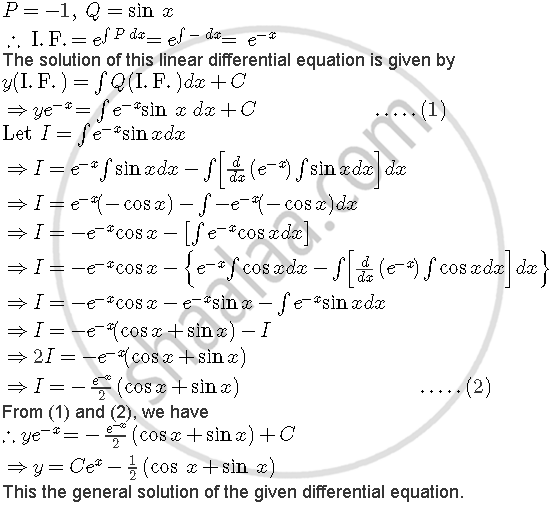
Find the general solution of the differential equation `dy/dx - y = sin x`
Advertisements
उत्तर
The given differential equation is
`dy/dx - y = sin x` .....(1)
Clearly, it is a linear differential equation of the form `dy/dx + Py=Q`
Here
APPEARS IN
संबंधित प्रश्न
For the differential equation, find the general solution:
`dy/dx + 3y = e^(-2x)`
For the differential equation, find the general solution:
y dx + (x – y2) dy = 0
Find the equation of a curve passing through the point (0, 2) given that the sum of the coordinates of any point on the curve exceeds the magnitude of the slope of the tangent to the curve at that point by 5.
(x + tan y) dy = sin 2y dx
Find the general solution of the differential equation \[\frac{dy}{dx} - y = \cos x\]
Solve the differential equation \[\left( y + 3 x^2 \right)\frac{dx}{dy} = x\]
Solve the following differential equation:-
\[\left( 1 + x^2 \right)\frac{dy}{dx} - 2xy = \left( x^2 + 2 \right)\left( x^2 + 1 \right)\]
Solve the differential equation: `(1 + x^2) dy/dx + 2xy - 4x^2 = 0,` subject to the initial condition y(0) = 0.
Solve the following differential equation:
`("x" + 2"y"^3) "dy"/"dx" = "y"`
Solve the following differential equation:
`"x" "dy"/"dx" + "2y" = "x"^2 * log "x"`
Solve the following differential equation:
dr + (2r cotθ + sin2θ)dθ = 0
Find the equation of the curve passing through the point `(3/sqrt2, sqrt2)` having a slope of the tangent to the curve at any point (x, y) is -`"4x"/"9y"`.
If the slope of the tangent to the curve at each of its point is equal to the sum of abscissa and the product of the abscissa and ordinate of the point. Also, the curve passes through the point (0, 1). Find the equation of the curve.
The integrating factor of the differential equation sin y `("dy"/"dx")` = cos y(1 - x cos y) is ______.
The integrating factor of the differential equation `x (dy)/(dx) - y = 2x^2` is
The integrating factor of differential equation `(1 - y)^2 (dx)/(dy) + yx = ay(-1 < y < 1)`
State whether the following statement is true or false.
The integrating factor of the differential equation `(dy)/(dx) + y/x` = x3 is – x.
If y = y(x) is the solution of the differential equation, `(dy)/(dx) + 2ytanx = sinx, y(π/3)` = 0, then the maximum value of the function y (x) over R is equal to ______.
Let y = y(x) be the solution curve of the differential equation `(dy)/(dx) + ((2x^2 + 11x + 13)/(x^3 + 6x^2 + 11x + 6)) y = ((x + 3))/(x + 1), x > - 1`, which passes through the point (0, 1). Then y(1) is equal to ______.
If the slope of the tangent at (x, y) to a curve passing through `(1, π/4)` is given by `y/x - cos^2(y/x)`, then the equation of the curve is ______.
If sin x is the integrating factor (IF) of the linear differential equation `dy/dx + Py` = Q then P is ______.
The solution of the differential equation `dx/dt = (xlogx)/t` is ______.
Find the general solution of the differential equation:
`(x^2 + 1) dy/dx + 2xy = sqrt(x^2 + 4)`
The slope of tangent at any point on the curve is 3. lf the curve passes through (1, 1), then the equation of curve is ______.
The slope of the tangent to the curve x = sin θ and y = cos 2θ at θ = `π/6` is ______.
