Advertisements
Advertisements
Question
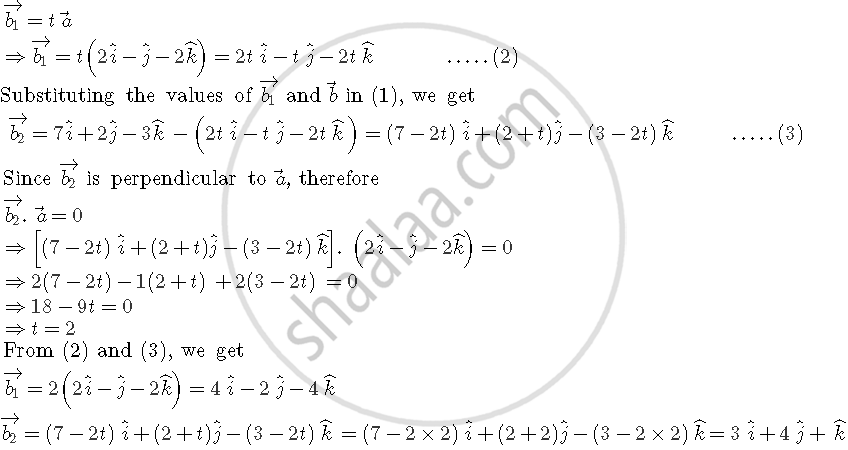
if `veca = 2hati - hatj - 2hatk " and " vecb = 7hati + 2hatj - 3hatk`, , then express `vecb` in the form of `vecb = vec(b_1) + vec(b_2)`, where `vec(b_1)` is parallel to `veca` and `vec(b_2)` is perpendicular to `veca`
Advertisements
Solution
Let `veca = 2hati - hatj - 2hatk " and " vecb = 7hati + 2hatj - 3hatk`
Now, `vec(b_1)` and `vec(b_2)` are two vectors such that
`vecb = vec(b_1) + vec(b_2)`
`=> vec(b_2) = vecb - vec(b_1)` ....(1)
Since `vec(b_1)`is parallel to `veca`, therefore
shaalaa.com
Is there an error in this question or solution?
