Advertisements
Advertisements
Question
Find the co-ordinates of the point which divides the join of A(-5, 11) and B(4,-7) in the ratio 7 : 2
Advertisements
Solution
The end points of AB are A(-5, 11) and B(4,-7)
Therefore `(x_1=-5, y
_1=11) and (x_2 = 4, y_2 = -7)`
Also, m = 7 and n= 2
Let the required point be p(x,y) .
By section formula, we get
`x = ((mx_2 +nx_1))/((m+n)) , y= ((my_2+ny_1))/((m+n))`
`⇒ x = ({ 7 xx 4 + 2 xx (-5)})/(7 +2) , y = ({ 7xx (-7) + 2 xx11})/(7 +2)` `⇒ x = (28-10)/9 , y = (-49 +22)/9`
`⇒ x = 18/9 , y = -27/9 `
Therefore , x = 2 and y = -3
Hence, the required point are P =(2,-3).
APPEARS IN
RELATED QUESTIONS
The coordinates of the point P are (−3, 2). Find the coordinates of the point Q which lies on the line joining P and origin such that OP = OQ.
In Fig. 14.36, a right triangle BOA is given C is the mid-point of the hypotenuse AB. Show that it is equidistant from the vertices O, A and B.
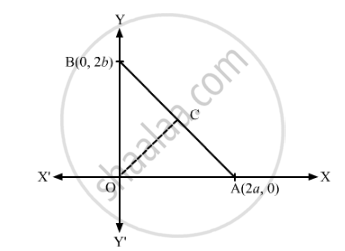
We have a right angled triangle,`triangle BOA` right angled at O. Co-ordinates are B (0,2b); A (2a, 0) and C (0, 0).
The points (3, -4) and (-6, 2) are the extremities of a diagonal of a parallelogram. If the third vertex is (-1, -3). Find the coordinates of the fourth vertex.
Find the ratio in which the line segment joining (-2, -3) and (5, 6) is divided by y-axis. Also, find the coordinates of the point of division in each case.
Find the coordinates of the points which divide the line segment joining the points (-4, 0) and (0, 6) in four equal parts.
Find the point on x-axis which is equidistant from points A(-1,0) and B(5,0)
Show that the points (−2, 3), (8, 3) and (6, 7) are the vertices of a right triangle ?
The abscissa and ordinate of the origin are
Two points having same abscissae but different ordinate lie on
ABCD is a parallelogram with vertices \[A ( x_1 , y_1 ), B \left( x_2 , y_2 \right), C ( x_3 , y_3 )\] . Find the coordinates of the fourth vertex D in terms of \[x_1 , x_2 , x_3 , y_1 , y_2 \text{ and } y_3\]
Find the value of k, if the points A (8, 1) B(3, −4) and C(2, k) are collinear.
Find the area of triangle with vertices ( a, b+c) , (b, c+a) and (c, a+b).
If the points (k, 2k), (3k, 3k) and (3, 1) are collinear, then k
If the centroid of the triangle formed by the points (a, b), (b, c) and (c, a) is at the origin, then a3 + b3 + c3 =
The distance of the point (4, 7) from the x-axis is
The coordinates of the circumcentre of the triangle formed by the points O (0, 0), A (a, 0 and B (0, b) are
The point on the x-axis which is equidistant from points (−1, 0) and (5, 0) is
If A(x, 2), B(−3, −4) and C(7, −5) are collinear, then the value of x is
Point P(– 4, 2) lies on the line segment joining the points A(– 4, 6) and B(– 4, – 6).
The distance of the point (–6, 8) from x-axis is ______.
