Advertisements
Advertisements
Question
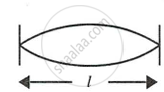
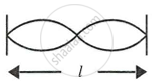
Fig. shows three ways in which a string of length l in an instrument can vibrate.
 |
 |
 |
| (i) | (ii) | (iii) |
- Which of the diagram shows the principle note?
- Which vibration has the frequency four times that of the first?
- Which vibration is of the longest wavelength?
- What is the ratio of the frequency of the vibration in (i) and (ii)?
Advertisements
Solution
- (i) represents the principal note.
- (iii) has the frequency four (4) times of the first.
- In Figure (i), vibration is of the longest wavelength.
- Ratio of frequency between (i) and (ii) 1 : 2
RELATED QUESTIONS
How do we produce sound ?
What is sound? What type of waves are sound wave in air?
The sound of an explosion on the surface of a lake is heard by a boat man 100 m away and by a diver 100 m below the point of explosion.
(i) Who would hear the sound first: boatman or diver?
(ii) Give a reason for your answer in part (i).
(iii) If sound takes time t to reach the boatman, how much time approximately does it take to reach the diver?
A continuous progressive transverse wave of frequency 8 Hz moves across the surface of a ripple tank
With reference to the frequency, describe the movement of water on the surface
The distance between one crest and one trough of a sea wave is 4.5 m. If the waves are produced at the rate of 240/min, calculate the time period.
Match the following
| 1. | Infrasonic | (a) | Compressions |
| 2. | Echo | (b) | 22 kHz |
| 3. | Ultrasonic | (c) | 10 Hz |
| 4. | High-pressure region | (d) | Ultrasonography |
An earthquake produces which kind of sound before the mainshock wave begins
Write any two uses of ultrasonic sound.
