Two tuning forks A and B of frequencies 256 Hz and 192 Hz respectively are vibrated in air. If the wavelength of A is 1.25 m, calculate the wavelength produced by B.
Advertisements
Question
Two tuning forks A and B of frequencies 256 Hz and 192 Hz respectively are vibrated in air. If the wavelength of A is 1.25 m, calculate the wavelength produced by B.
Advertisements
Solution
Frequency of tuning fork A = fA = 256 Hz
Frequency of tuning fork B = fB = 192 Hz
Wavelength produced in A = λA = 1.25 m
Wavelength produced in B = λB = ?
Case - I
v = λAfA
v = 1.25 × 256
v = 320 ms-1
Case - II
v = λBfB
λB = `"v"/"f"_"B"`
λB = `320/192 = 1.67` m
APPEARS IN
RELATED QUESTIONS
How are the wavelength and frequency of a sound wave related to its speed?
The longitudinal waves travel in a coiled spring at a rate of 4 m/s. The distance between two consecutive compressions is 20 cm. Find :
(i) Wavelength of the wave (ii) Frequency of the wave
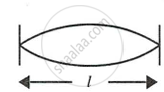
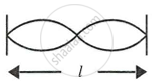
Fig. shows three ways in which a string of length l in an instrument can vibrate.
 |
 |
 |
| (i) | (ii) | (iii) |
- Which of the diagram shows the principle note?
- Which vibration has the frequency four times that of the first?
- Which vibration is of the longest wavelength?
- What is the ratio of the frequency of the vibration in (i) and (ii)?
Define sound ranging.
What is musical sound? Give an example.
How do the following factor affect the speed of sound in air?
Temperature of air
Name the factors on which the speed of sound depends.
Longitudinal waves are produced in solids liquids and also in gases.
Two sound waves X and Y have the same amplitude and the same wave pattern but their frequencies are 60 Hz and 120 Hz respectively, then ______.
