Advertisements
Advertisements
Question
Explain why Lewis acid is not required in bromination of phenol?
Advertisements
Solution
Usual halogenation is carried out in the presence of Lewis acid, \[\ce{FeBr3}\] which polarises the halogen molecule. In case of phenol, the polarisation of bromine occurs even in the absence of Lewis acid. This is because of highly activating effect of –OH group on the benzene ring. The reaction follows:

Note: In aqueous solution, phenol ionizes to give phenoxide ion. Due to the presence of the negative charge, the oxygen atom of the phenoxide ion donates electrons to the benzene ring to a large extent. As a result, the ring gets highly activated leading to the formation of trisubstituted product. On the other hand, in the non-polar solvents, the ionization of phenol does not occurs to a large extent. As a result, the -OH group donates electrons to the benzene ring only to a small extent. Consequently, the ring is activated slightly and, therefore, only monosubstitution occurs.
APPEARS IN
RELATED QUESTIONS
Give the IUPAC name of the following ether:
CH3OCH2CH2Cl
Give the IUPAC name of the following ether:
CH3CH2CH2OCH3
Ethylidene dichloride when boiled with aqueous solution of NaOH yields _______.
(A) formaldehyde
(B) acetaldehyde
(C) acetone
(D) ethyl methyl ketone
Write the IUPAC name of the following compound:
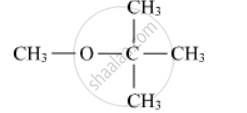
Write the structures of the products when Butan-2-ol reacts with CrO3
How do you convert the Ethanal to Propanone
What.will be the product fonned when chlorobenzene is heated with sodium metal in the presence of dry ether?
3-methylphenol is called ____________.
Butane-2-ol is ____________.
Which of the following compounds is oxidised to prepare methyl ethyl ketone?
n-Propyl alcohol and isopropyl alcohol can be chemically distinguished by which reagent?
IUPAC name of m-cresol is ____________.
The major product formed by the reaction:
\[\begin{array}{cc}
\ce{CH3CH-CH2Br ->[CH3O^-][CH3OH] is}\\
|\phantom{................}\\
\ce{CH3}\phantom{.............}
\end{array}\]
The heating of phenyl methyl ether with HI produces:
The correct acidic strength order of the following is:

(I)

(II)

(III)
Give IUPAC name of the compound given below.
\[\begin{array}{cc}
\phantom{}\ce{CH3 - CH - CH2 - CH2 - CH - CH3}\phantom{.}\\
\phantom{.........}|\phantom{...................}|\phantom{...........}\\
\phantom{..}\ce{Cl}\phantom{.................}\ce{OH}\phantom{..}
\end{array}\]
Explain why p-nitrophenol is more acidic than phenol.
Match the structures of the compounds given in Column I with the name of the compounds given in Column II.
| Column I | Column II | |
| (i) |  |
(a) Hydroquinone |
| (ii) |  |
(b) Phenetole |
| (iii) | 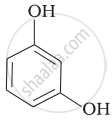 |
(c) Catechol |
| (iv) |  |
(d) o-Cresol |
| (v) |  |
(e) guinone |
| (vi) | 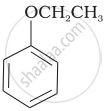 |
(f) Resorcinol |
| (g) Anisole |
Draw structure of the following compound.
2-Methoxypropane
Write structural formulae for:
Salicylic acid
