Advertisements
Advertisements
Questions
Explain the mechanism of closing and opening of the stomata.
Explain the mechanism of stomatal respiration with the help of a labelled diagram.
Advertisements
Solution
The closing and opening of the stomata depends on the turgidity of the guard cells. Each guard
cell has a thicker wall on the side facing the stoma and a thin wall on the opposite side. Guard cells contain chloroplasts. As a result of the synthesis of glucose during photosynthesis and some other chemical changes, the osmotic pressure of the contents of the guard cells increases and they absorb more water from the neighbouring cells, thus becoming turgid. Due to turgor, the guard cells become more arched outwards and the aperture between them widens, thereby opening the stoma.

At night or when there is shortage of water in the leaf, the guard cells turn flaccid and their inner rigid walls become straight, thus closing the stomatal aperture.
APPEARS IN
RELATED QUESTIONS
The diagram of an given below demonstrates a particular process in plants. Study the same and answer the questions that follow:
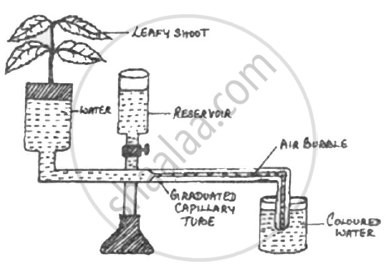
- Name the apparatus.
- Which phenomenon is demonstrated by this apparatus?
- Explain the phenomenon mentioned in (ii) above.
- State two limitations of using this apparatus.
- What is the importance of the air bubble in the experiment?
- Name the structures in a plant through which the above process takes place.
How is root hair adapted for the absorption of water from the soil?
Choose the correct answer:
Exudation or bleeding is associated with ___________
A thin strip of epidermal cells from the fleshy scales of an onion bulb was examined in a drop of water, under a microscope. All the epidermal cells looked alike and the figure alongside represents one of them. The thin strip was then transferred to a drop of strong sugar solution and re-examined under the microscope after about five minutes.

(i) Make a sketch of one of the epidermal cells, as it might appear after immersion in a strong sugar solution. Label any two parts which have undergone a change.
(ii) Give the scientific term for the change shown in Q.(i) above.
(iii) What would you do to bring this cell back to its original condition?
(iv) Give the scientific term used for the recovery of the cell as a result of the step taken in Q.(iii) above.
Name the following:
Root hairs are the extension of which cells.
____________plants like orchids absorb water vapours from air with the help of epiphytic roots having special tissue called velamen.
Epiphytic plants like orchids absorb water vapours from air with the help of ______ having special tissue called velamen.
Roots of the plants absorb water from the soil through the process of ____________.
Root hair is a cytoplasmic extension of ______.
Water in the root enters due to ______.
