Advertisements
Advertisements
Questions
Explain the haplo-diploid method of sex determination in the honey bee.
Explain Haplodiploidy in honey-bees.
Advertisements
Solution 1

- In honey bees, the chromosomal mechanism of sex determination is of haplo-diploid type.
- In this type, the sex of the individual is determined by the number of the set of chromosomes received.
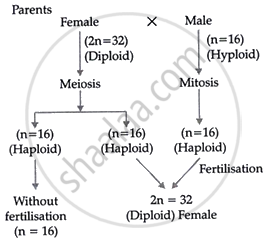
- Females are diploid (2n = 32) and males are haploid (n = 16).
- The female produces haploid eggs (n = 16) by meiosis and male produces haploid sperms (n = 16) by mitosis.
- If the egg is fertilized by sperm, the zygote develops into a diploid female (2n = 32) (queen and worker), and an unfertilized egg develops into a haploid male (n = 16) (Drone) by way of parthenogenesis.
- The diploid female gets differentiated into either a worker or a queen bee depending on the food they consume during their development.
- Diploid larvae that get royal jelly as food develop into queens (fertile females) and others develop into workers (sterile females).
Solution 2
In honey bees, haplodiploidy is a sex determination method in which an individual’s sex is dictated by the number of sets of chromosomes they are given.
In honey bees:
- Queen and worker bees are diploid, meaning they have two sets of chromosomes, and they develop from fertilized eggs.
- Male drones develop from unfertilized eggs and have one pair of chromosomes, making them haploid. According to this arrangement, females receive two sets of chromosomes, one from the queen and one from a male drone, while males receive only one, which is fully inherited from the queen.
Haplo-diploid sex determination system:
RELATED QUESTIONS
Name the species used in sericulture. Name the stages in the life cycle of a silk moth in cyclic form.
There are ................ pairs of chromosomes in the human being.
A new born child has an XY pair of chromosmes. Will it be a baby boy or a baby girl?
In a human, how many chromosmes are present in a fertilised egg?
Which combination of genes in the zygote will produce children with blue eyes?
________ shows haplo-diploid type of sex-determination.
With the help of a chart, explain the method of sex determination in honeybees.
Answer the following question:
How is sex determined in human beings? Explain with the help of a diagram.
How is sex determined in human beings?
Match the items of Column I with Column II:
| Column I | Column II | ||
| i. | XX-XO method of Sex Determination | a. | Turner syndrome |
| ii. | XX-XY method of Sex Determination | b. | Female heterog ametic |
| iii. | karyotype-45 | c. | Grasshopper |
| iv. | ZW-ZZ method of Sex Determination | d. | Female homogametic |
Identify the organism in which ZZ-ZW type of sex determination is observed.
Chromosomal constitution of normal human females can be written as ______.
Haplodiploidy is found in ______.
All human chromosomes ate not paired. Most human chromosomes have a maternal and a paternal copy, and we have 22 such pairs. But one pair called the sex chromosomes, is odd in not always being a perfect pair. Women have a perfect pair of sex chromosomes. But men have a mismatched pair in which one is normal sized while the other is a short one.
(a) In humans, how many chromosomes are present in a Zygote and in each gamete?
(b) A few reptiles rely entirely on environmental cues for sex determination. Comment.
(c) "The sex of a child is a matter of chance and none of the parents are considered to be responsible for it." Justify it through flow chart only.
OR
(c) Why do all the gametes formed in human females have an X chromosome?
Twins are born to a family that lives next door to you. The twins are a boy and a girl. Which of the following must be true?
Given below are two statements:
Statement - I: The male Drosophila has a pair of homomorphic sex chromosomes.
Statement - II: The male human being has a pair of heteromorphic sex chromosomes.
In the light of above statements, Choose the most appropriate answer from the options given below:
In the XX–XY sex determination system, which sex is considered heterogametic and produces two different types of gametes?
In the haplodiploidy system observed in honeybees, unfertilized eggs develop into which type of individual?
In the haplodiploidy system observed in honeybees, fertilized eggs develop into which type of individual?
In the XX–XY sex determination system, if a female (XX) is fertilized by an X-bearing sperm, what is the resulting genotype of the offspring?
