Advertisements
Advertisements
प्रश्न
Explain the haplo-diploid method of sex determination in the honey bee.
Explain Haplodiploidy in honey-bees.
Advertisements
उत्तर १

- In honey bees, the chromosomal mechanism of sex determination is of haplo-diploid type.
- In this type, the sex of the individual is determined by the number of the set of chromosomes received.
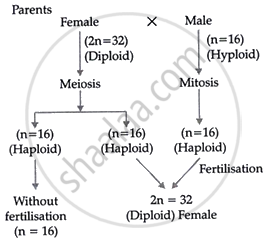
- Females are diploid (2n = 32) and males are haploid (n = 16).
- The female produces haploid eggs (n = 16) by meiosis and male produces haploid sperms (n = 16) by mitosis.
- If the egg is fertilized by sperm, the zygote develops into a diploid female (2n = 32) (queen and worker), and an unfertilized egg develops into a haploid male (n = 16) (Drone) by way of parthenogenesis.
- The diploid female gets differentiated into either a worker or a queen bee depending on the food they consume during their development.
- Diploid larvae that get royal jelly as food develop into queens (fertile females) and others develop into workers (sterile females).
उत्तर २
In honey bees, haplodiploidy is a sex determination method in which an individual’s sex is dictated by the number of sets of chromosomes they are given.
In honey bees:
- Queen and worker bees are diploid, meaning they have two sets of chromosomes, and they develop from fertilized eggs.
- Male drones develop from unfertilized eggs and have one pair of chromosomes, making them haploid. According to this arrangement, females receive two sets of chromosomes, one from the queen and one from a male drone, while males receive only one, which is fully inherited from the queen.
Haplo-diploid sex determination system:
संबंधित प्रश्न
Explain the mechanism of 'sex determination' in birds. How does it differ from that of human beings?
Explain how, sex is determined in human babies.
Choose the correct answer from the four options given below :
In a human male, a sperm will contain :
Define the following:
Sex-linked characters
Choose the correct answer:
A single recessive trait, able to express must be on _________
Complete the following sentence with appropriate word:
______are the alternative forms of a gene producing different effects.
Kavitha gave birth to a female baby. Her family members say that she can give birth to only female babies because of her family history. Is the statement given by her family members true? Justify your answer.
Read the following statements and select the correct option.
i. If sperm containing Y chromosome fertilizes the ovum, then diploid zygote is formed that grows into a male child.
ii. If sperm containing X chromosome fertilizes ovum, then diploid zygote is formed, that grows into a female child.
Diploid larvae which get royal jelly as food develops into ____________ and other develops into workers (sterile females).
Number of autosomes present in liver cells of a human female is ______.
A zygote which has an X-chromosome inherited from the father will develop into a
Which of the following statements is not true with respect to variation?
Some dinosaurs had feathers although they could not fly but birds have feathers that help them to fly. In the context of evolution this means that
Sex in honey bee is determined by ______.
A zygote which has Y chromosome inherited from the father will develop into a ______.
Which biological mechanism establishes whether an individual develops as male or female based on genetic or chromosomal factors?
In 1891, H. Henking studied spermatogenesis in squash bugs and observed that a specific nuclear structure was present in what percentage of the resulting sperms?
If a male grasshopper with XO genotype produces sperm, what proportion of his sperm will carry the X chromosome?
In a bird population using the ZW–ZZ sex determination system, if a ZZ male mates with a ZW female, what proportion of offspring would be expected to be female?
