Advertisements
Advertisements
Question
Explain the froth floatation method with a neat labelled diagram.
Advertisements
Solution
- The froth floatation process is based on two opposite properties of the particles, hydrophilic and hydrophobic.
- The metal sulphide particles are hydrophobic. Due to this property, they get wetted mainly with oil. On the other hand, gangue particles are hydrophilic and get wetted by water.
- In this method, the finely divided metal ore is added in a big tank containing large amount of water. To this, certain vegetable oil (pine oil, eucalyptus oil, etc.) is added for the formation of froth.
- In the tank, compressed air is circulated through the water. Bubbles are formed due to this blown air. A rotating agitator at the centre of the floatation tank agitates the mixture and draws air into it to form bubbles. As a result, foam is formed which carries metal sulphide particles. The foam rises to the surface of water and floats. Therefore, this method is called froth floatation process.
- This method is used to separate metal sulphide ores such as zinc blende (ZnS) and copper pyrite (CuFeS2).
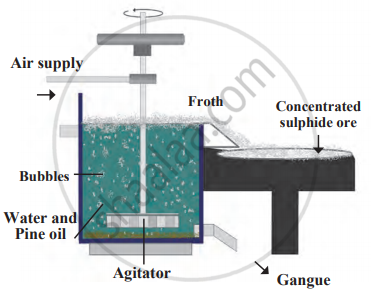
Froth floatation method
APPEARS IN
RELATED QUESTIONS
Metal A has an electronic configuration of 2, 8, 1 and metal B has 2, 8, 8, 2 which is more reactive metal.
Identify A and B and give their reactions with dil HCL and dil H2SO4 ?
Metal A has an electronic configuration of 2, 8, 1 and metal B has 2, 8, 8, 2 which is more reactive metal.
Give the effect of heat on their ?
oxides
Name:
(a) the processes involved in
concentration :-
Explain the following terms:
smelting
Name the methods used for purification?
`2Cu_2O +Cu_2S` ......................
`HgS + O_2` ..................
Where are the cathode and anode in the electrolytic cell? Name the material used for these?
state the reactions at the two electrodes ?
Which metal is used for:
making pipes, buckets, water tanks,
What is magnalium? Name the main elements present in it? Write its one use ?
A compound that is added to lower the fusion temperature of the electrolytic bath in the extraction of aluminium.
Why does iron or zinc not occur free in nature?
Write scientific reason.
Magnetic separation method is used to separate the magnetic ingredients in the ores.
Write the molecular formulae of the following compound.
Stannic oxide
Distinguish between:
Froth floatation - Leaching
Complete flow chart given below.

Complete the following flowchart.
Calculate the difference between heat of combustion of carbon monoxide gas at constant pressure and at constant volume at 27°C? (R = 2 cal K-1 mol-1).
