Advertisements
Advertisements
Question
Observe the given figure of reactivity series of metals and answer the following questions:
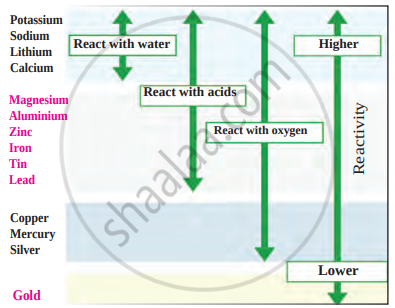
Reactivity series of metals
- Name two metals which react with water.
- Name two moderately reactive metals.
- Name the most highly reactive metal and the most less reactive metal.
Advertisements
Solution
- Two metals that react with water: Potassium, sodium
- Two moderately reactive metals: Zinc, iron
- 1. Most highly reactive metal: Potassium
2. Most less reactive metal: Gold
APPEARS IN
RELATED QUESTIONS
Name the following:
Main ore of aluminium.
Why do gold ornaments look new even after several years of use?
Give the name and chemical formula of one ore of copper.
Explain giving equation, what happens when:
ZnCO3 is heated in the absence of air?
Name the chemical compound which is electrolysed in molten state to obtain aluminium metal. Which gas is evolved during this process?
Which metal is extracted from cinnabar ore?
Which of the following pair of metals exists in their native state in nature?
Identify the process given in following passage and draw neat labelled diagram showing the process.
Electrolysis of molten mixture of alumina (melting point > 20000C) is done in a steel tank. The tank has a graphite lining on the inner side. This lining does the work of a cathode. A set of graphite rods dipped in the molten electrolyte works as anode. Cryolite (Na3AlF6) and fluorspar (CaF2) are added in the mixture to lower its melting point upto 10000C.
Name the following:
The mixture of materials fed into a furnace to extract a metal.
Define the term:
Flux
How is the method of extraction of metals high up in the reactivity series different from that for metals in the middle? Why can the same process not be applied for them? Name the process used for the extraction of these metals.
_______ is the least reactive metal.
Write the name.
Metals which are amphoteric in nature.
Write the name.
Strongly heating carbonate ores in insufficient air -
Bauxite reacts with sodium hydroxide in the Bayer’s process.
Write the molecular formulae of the following compound.
Fluorspar
Explain the following reaction with the balanced equation.
Zinc sulphide is heated strongly in excess of air
Explain in brief types of extraction of moderately reactive metals according to their reactivity.
Which of the following metals exist in their native state in nature?
- Cu
- Au
- Zn
- Ag
