Advertisements
Advertisements
प्रश्न
Explain the froth floatation method with a neat labelled diagram.
Advertisements
उत्तर
- The froth floatation process is based on two opposite properties of the particles, hydrophilic and hydrophobic.
- The metal sulphide particles are hydrophobic. Due to this property, they get wetted mainly with oil. On the other hand, gangue particles are hydrophilic and get wetted by water.
- In this method, the finely divided metal ore is added in a big tank containing large amount of water. To this, certain vegetable oil (pine oil, eucalyptus oil, etc.) is added for the formation of froth.
- In the tank, compressed air is circulated through the water. Bubbles are formed due to this blown air. A rotating agitator at the centre of the floatation tank agitates the mixture and draws air into it to form bubbles. As a result, foam is formed which carries metal sulphide particles. The foam rises to the surface of water and floats. Therefore, this method is called froth floatation process.
- This method is used to separate metal sulphide ores such as zinc blende (ZnS) and copper pyrite (CuFeS2).
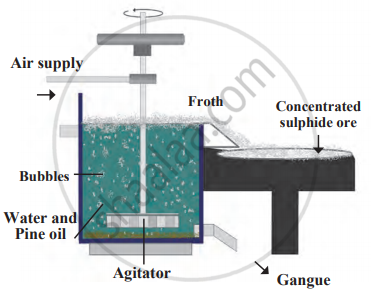
Froth floatation method
APPEARS IN
संबंधित प्रश्न
Give the importance of the following for living beings:
Nitrogen
Metal A has an electronic configuration of 2, 8, 1 and metal B has 2, 8, 8, 2 which is a more reactive metal.
Give the effect of heat on their: carbonates
Name the processes involved in refining of ores.
What do you observe when hydrogen is passed over heated copper oxide?
An ore on being heated in air forms sulphurous anhydride. Write the process used for the concentration of this ore.
Give the ionization reactions of electrolyte used in Hall’s process. write the reaction at the cathode and the anode. Why the anode has to be replaced in this process?
Name a metal which forms a liquid alloy at ordinary temperature.
What is magnalium? Name the main elements present in it? Write its one use ?
Name the following:
Name an allotrope of a non-metal that allows electricity to pass through it.
In Wilfley table method to separate particles of gangue _______ method is used.
Write the molecular formulae of the following compound.
Copper pyrite
Distinguish between:
Froth floatation - Leaching
Explain concept with example/explain with the help of a balanced equation.
Gangue
Complete flow chart given below.
Chemical formula of rust is ______
Zirconium is refined by ____________.
Which of following metals occurs in native state?
A process of extracting metals from aqueous solutions of their salts using suitable reducing agents is called ______
