Advertisements
Advertisements
Questions
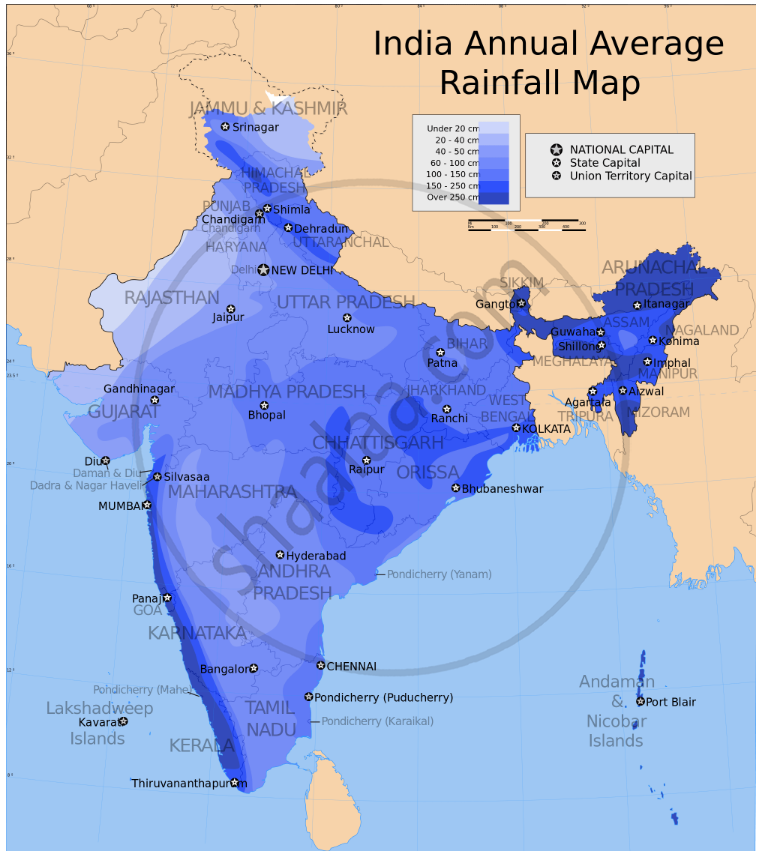
Explain How is distribution of annual rainfall in related to the relief of the country? with examples.
How is distribution of annual rainfall in related to the relief of the country?
Advertisements
Solution
The Western Ghats: places to the windward side of the Ghats, e.g., Mumbai, Goa, Mangalore, Kerala coasts, get heavy rain. Places on the leeward side like Pune, the Deccan plateau, Chennai, get less rain.
Garo-Khasi Hills: Cherrapunji, which is favourably situated in these hills, gets entrapped in the Bay of Bengal branch of the S.W. Monsoon and gets very heavy rain; Shillong, which lies on the leeward side of these Hills gets less rain.
Aravalli Hills: These hills run parallel to the Arabian Sea branch of the S.W. Monsoon and are not conducive to rain. Besides, the Bay of Bengal winds of the S.W. Monsoon coming from the east is blocked and hence Rajasthan, lying on the leeward side of these Hills, gets little rain. This is why Thar is a desert.
The Himalaya Mountains block the Bay of Bengal branch of the S.W. Monsoon from crossing the mountains. The places on the southern slopes of the Mountains get heavy rain.
APPEARS IN
RELATED QUESTIONS
Name the following: The local wind that brings a light rainfall to South India and is good for tea and
coffee crops.
Give an account of weather conditions and characteristics of the cold season.
Rajasthan receives very little rainfall.
Study the climatic data given below and answer the questions that follow:
| Month | Jan. | Feb. | Mar. | Apr. | May | Jun. | Jul. | Aug. | Sep. | Oct. | Nov. | Dec. |
| °C | 25.0 | 25.5 | 26.3 | 27.1 | 30.0 | 36.2 | 36.0 | 35.9 | 30.3 | 28.4 | 27.0 | 24.6 |
| cm | 24.5 | 23.1 | 15.0 | 2.4 | 0.1 | 11.0 | 9.3 | 7.2 | 4.0 | 9.4 | 14.5 | 20.4 |
(i) Calculate the annual temperature range.
(ii) What is the total annual rainfall?
(iii) Presuming that the station is located in India, give a reason for its location being on the east coast or the west coast of India.
The source of the winter rain to Tamil Nadu.
The average rainfall of India is about ______.
The amount of rainfall received by ______ is 100 to 200 cm of rainfall.
The average rainfall of India is about:
Write a note on the uneven distribution of rainfall in India.
Now find out
Why is Shillong rainier than Kolkata?
