Advertisements
Advertisements
Questions
Explain haloform reaction with suitable example.
Write a note on the Haloform reaction.
Advertisements
Solution
- This reaction is given by acetaldehyde, all methyl ketones (CH3–CO–R), and all alcohols containing CH3(CHOH)– group.
- When an alcohol or methyl ketone is warmed with sodium hydroxide and iodine, a yellow precipitate is formed. Here the reagent sodium hypoiodite is produced in situ.
- During the reaction, the sodium salt of the carboxylic acid is formed which contains one carbon atom less than the substrate.
- The methyl group is converted into haloform (CHX3).
e.g. Acetone is oxidized by sodium hypoiodite to give sodium salt of acetic acid and yellow precipitate of iodoform.
\[\begin{array}{cc}
\phantom{..}\ce{O}\phantom{.......................................}\ce{O}\phantom{..........................}\\
\phantom{..}||\phantom{.......................................}||\phantom{..........................}\\
\ce{\underset{\text{Acetone}}{CH3 - C - CH3} + \underset{\text{Sodium hypoiodite}}{3NaOI} ->[NaOH/I2][\Delta] \underset{\text{Sodium acetate}}{CH3 - C - O- Na+} + \underset{\text{Iodoform}}{CHI3 ↓} + 2NaOH}
\end{array}\]
RELATED QUESTIONS
Benzaldehyde does NOT show positive test with ______.
Write reaction showing aldol condensation of cyclohexanone.
Write the name of the product when ketones react with 1,2-diol in presence of dry HCl.
Identify the INCORRECT reaction.
Which of following is not a property of red phosphorus?
Which among the following compounds does NOT undergo aldol condensation?
Which of the following does NOT give yellow precipitate when reacted with (NaOH + I2) mixture?
The formation of cyanohydrin from acetone is an example of ____________.
Phenyl methanal is reacted with concentrated NaOH to give two products X and Y. X reacts with metallic sodium to liberate hydrogen X and Y are ____________.
Identify X and Y.
\[\ce{CH3COCH2CH2COOC2H5 ->[CH3MgBr] X ->[H3O^+] Y}\]
What is the action of HCN on 2, 4-dichlorobenzaldehyde?
How is the following conversion effected propanal into butanone?
How will you prepare malachite green from benzaldehyde?
How will you prepare cinnamic acid from benzaldehyde?
How propanal is converted into propane.
Primary nitroalkanes are obtained in good yield by oxidising aldoximes with the help of ______.
Which one of the following substituents at para-position is most effective in stabilizing the phenoxide  ion?
ion?
Which one of the following reactions will not result in the formation of a carbon-carbon bond?
What is the number of different products formed when mixture of ethanal and propanal reacts with aq. NaOH after warming?
Write the structure of the products obtained from the following ketones by action of hydrazine in presence of a slightly acidic medium.


Write the structure of the major product of the aldol condensation of benzaldehyde with acetone.
How will you prepare acetic anhydride from acetic acid.
Write the structure of the major product of the aldol condensation of benzaldehyde with acetone.
How will you prepare Acetic anhydride from acetic acid.
How will you prepare acetic anhydride from acetic acid?
Which from following tests confirms presence of aldehydic group in glucose?
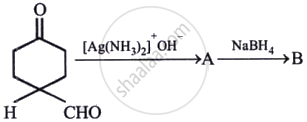
The products formed in the following reaction, A and B are:
Which from following compounds does NOT undergo haloform reaction?
