Advertisements
Advertisements
Question
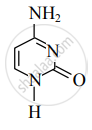
Draw structure of following.
Cytosine
Advertisements
Solution
APPEARS IN
RELATED QUESTIONS
The following statement applies to DNA only, some to RNA only, and some to both. Label them accordingly.
The polynucleotide is double stranded. (_______)
Write the sequence of the complementary strand for the following segment of a DNA molecule.
5' - CCGGTTAATACGGC - 3'
In which of the following structure of DNA carries genetic information of the organism?
Define the following term.
nucleoside
Draw structure of following.
2-Deoxy-D-ribose
Distinguish between Nitrogen base and a base found in inorganic chemistry.
Explain the structure and function of different types of RNA.
______ is NOT a pyrimidine.
In an experiment, DNA was found to have 31 % adenine and 19% guanine. Identify the percentage of cytosine in the given molecule of DNA.
Which pair of bases is present both in DNA and RNA?
DNA differs from RNA in ______.
What is the number of \[\begin{array}{cc}\\\backslash\phantom{.......}\\\phantom{}\ce{C = O}\\/\phantom{........}\end{array}\] groups present in nitrogen bases of nucleic acids, thymine and uracil respectively?
What are different types of RNA which are found in cells?
Building block of nucleic acid is ______.
Which of the following are substituted purines?
Draw a neat diagram for the following:
AMP
Watson and Crick (1953) proposed DNA double helix model and won the Nobel Prize; their model of DNA was based on:
- X-ray diffraction studies of DNA were done by Wilkins and Franklin.
- Chargaff’s base equivalence rule
- Griffith's transformation experiment
- Meselson and Stahl's experiment
Which of the following are correct combination of purine bases?
Name two kinds of nucleic acids.
What is the primary structural feature of DNA according to the Watson and Crick Model?
What is the primary function of DNA in living organisms?
Which application of nucleic acid principles is used for personal identification and forensic investigation?
Which nitrogenous bases are classified as pyrimidines?
What organic classification do nitrogenous bases belong to?
