Advertisements
Advertisements
Question
Draw a neat labelled diagram showing a pulley being used to lift a load. How are load and effort related in an ideal situation?
Advertisements
Solution
To raise a load, the load is attached to one end of the string and the effort is applied at the other end by pulling it is a downward direction . as shown in fig.

APPEARS IN
RELATED QUESTIONS
A pulley system has three pulleys. A load of 120 N is overcome by applying an effort of 50 N. Calculate the Mechanical Advantage and Efficiency of this system.
A block and tackle system has V.R. = 5.
Rohan exerts a pull of 150 kgf. What is the maximum load he can raise with this pulley system if its efficiency = 75%?
The pulley system has drawn lifts a load of 150 N when an effort of 60 N is applied. Find its mechanical advantage.
What is the justification for using the pulley then ?
Solve the following numerical problem.
What effort will be required to lift a load of 500 N by a single movable pulley? [Hint: Mechanical advantage of a single movable pulley is two].
The diagram below shows a pulley arrangement.
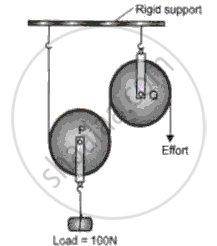
(i) In the diagram, mark the direction of the forces due to tension, acting on the pulley P.
(ii) What is the purpose of the pulley Q?
(iii) If the tension is T newton, deduce the relation between T and E.
(iv) Calculate the velocity ratio of the arrangement.
(v) Assuming that the efficiency of the system is 100%, what is the mechanical advantage?
(vi) Calculate the value of E
Name the type of single pulley that can act as a force multiplier. Draw a labeled diagram of the pulley mentioned by you.
Give reason for the following:
The efficiency of a pulley is always less than 100%
What is a pulley?
_______ is a machine made up of wheel and rope.
