Advertisements
Advertisements
Questions
Draw and label the diagram.
Nephron
Draw a well-labelled diagram of nephron and label atleast 4 of its parts.
Advertisements
Solution
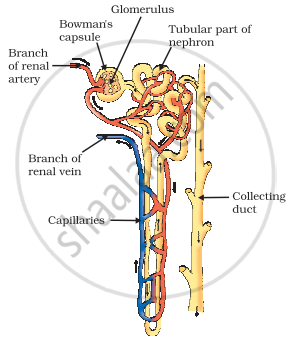
Notes
Students should refer to the answer according to their questions.
RELATED QUESTIONS
Match the items of column I with those of column II:
| Column I | Column II | ||
| (a) | Ammonotelism | (i) | Birds |
| (b) | Bowman’s capsule | (ii) | Bowman’s capsule |
| (c) | Micturition | (iii) | Bony fish |
| (d) | Uricotelism | (iv) | Urinary bladder |
| (e) | ADH | (v) | Renal tubule |
Write down the functional activity of the following parts,
Glomerulus …………………
Differentiate between the following pairs of term :
Urea and urine
Choose the correct answer:
Presence of RBCs in urine is called _____________
The given diagram represents a nephron and its blood supply. Study the diagram and answer the following question :
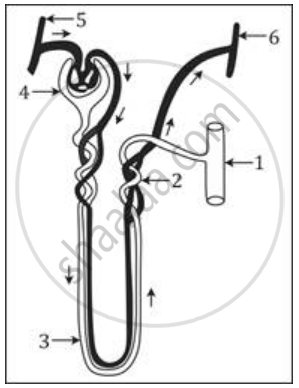
Label parts 1, 2, 3 and 4.
Draw a neat and well labeled diagram of human excretory system.
Why is urine yellow in colour ?
How is urea produced?
Explain the Term: The Bowman’s capsule
Write the functional activity of the following structure: Adrenal gland
Choose the Odd One Out:
Choose the correct option.
Which one of the following is not a part of human kidney?
Differentiate the following.
Excretion and Secretion
The human kidneys are located on either side of the vertebral column at the level of ______.
Select the INCORRECT match.
Read the following terms given below.
| root hairs | xylem | urethra |
| arteries | kidneys | veins |
| atria | capillaries | heart |
| ureter | phloem | urinary bladder |
Group the terms on the basis of the categories given below.
- Circulatory system of animals.
- Excretory system in human.
- Transport of substances in plants.
Match the terms given in Column I with their physiological processes given in Column II and choose the correct answer
| Column I | Column II |
| A. Proximal convoluted tubule | i. Formation of concentrated urine |
| B. Distal convoluted tubule | ii. Filtration of blood |
| C. Henle's loop | iii. Reabsorption of 70 - 80% of electrolytes |
| D. Counter-current mechanism | iv. Ionic balance |
| E. Renal corpuscle | v. Maintenance of concentration gradient in medulla |
Match Column I with Column II.
| Column I | Column II |
| A. PCT | (i) Concentrated urine formation |
| B. DCT | (ii) Filtration of blood |
| C. Loop of Henle | (iii) Reabsorption of 70-80% of the electrolyte |
| D. Counter current mechanism | (iv) Ionic balance |
| E. Renal corpuscle | (v) Maintenance of concentration gradient in medulla |
Select the correct option from the codes given below.
Complete the following analogy.
Parietal wall of Bowman’s capsule : squamous epithelium : : PCT : ______ epithelium.
