Advertisements
Advertisements
Question
Match the terms given in Column I with their physiological processes given in Column II and choose the correct answer
| Column I | Column II |
| A. Proximal convoluted tubule | i. Formation of concentrated urine |
| B. Distal convoluted tubule | ii. Filtration of blood |
| C. Henle's loop | iii. Reabsorption of 70 - 80% of electrolytes |
| D. Counter-current mechanism | iv. Ionic balance |
| E. Renal corpuscle | v. Maintenance of concentration gradient in medulla |
Options
A - iii, B - v, C - iii, D - ii, E - i
A - iii, B - iv, C - i, D - v, E - ii
A - i, B - iii, C - ii, D - v, E - iv
A - iii, B - i, C - iv, D - v, E - ii
Advertisements
Solution
A - iii, B - iv, C - i, D - v, E - ii
Explanation:
| Column I | Column II |
| A. Proximal convoluted tubule | iii. Reabsorption of 70 - 80% of electrolytes |
| B. Distal convoluted tubule | iv. Ionic balance |
| C. Henle's loop | i. Formation of concentrated urine |
| D. Counter-current mechanism | v. Maintenance of concentration gradient in medulla |
| E. Renal corpuscle | ii. Filtration of blood |
APPEARS IN
RELATED QUESTIONS
Tick the most appropriate answer.
The Bowman’s capsule and glomerulus together form the
Write down the functional activity of the following parts,
Glomerulus …………………
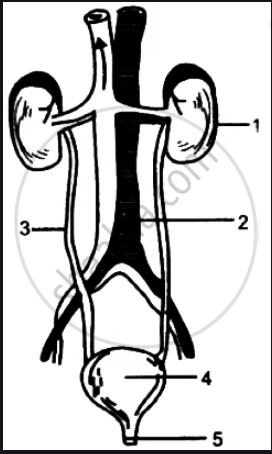
Given below is the figure of certain organs and associated parts in the human body. Study the same and answer the question that follow:
Name the structural and functional unit of the part marked '1'.
Sketch and label the ultrastructure of nephron.
Name the Following
A process by which the unwanted nitrogenous wastes are eliminated from the body.
Name the Following
The act of passing urine.
Give Technical Terms:
The pigments produced by the breakdown of haemoglobin in liver.
Choose the Odd One Out:
Name the three filtration barriers that solutes must come across as they move from plasma to the lumen of Bowman’s capsule. What components of the blood are usually excluded by these layers?
The point where the ureter arises from the kidney to where it opens into the urinary bladder is about ____________ cm.
What is the CORRECT sequence of the different parts of the nephron from Malpighian corpuscle?
Maximum amount of urea is present in the blood carried by the ____________.
The collecting tubule of the kidney is important as it helps in ______.
The glomerular capillaries filter out its contents due to ____________.
______ gland is located above the kidney.
The loop of Henle lies in ______.
Draw the human excretory system and label the parts.
Kidneys are reddish brown and
Erythropoietin hormone which stimulates R.B.C. formation is produced by ______.
The maximum amount of electrolytes and water (70-80%) from the glomerular filtrate is reabsorbed in which part of the nephron.
