Advertisements
Advertisements
Question
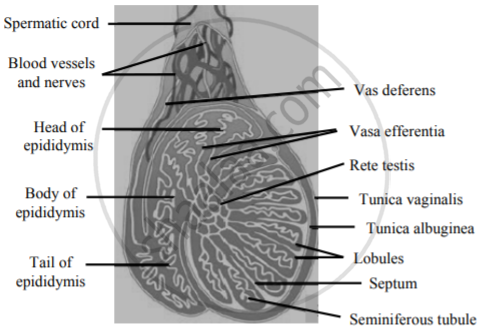
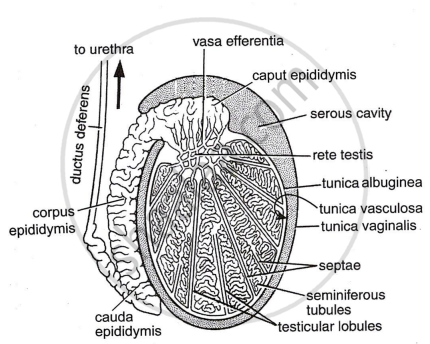
Draw a well labelled diagram of L.S. human testis.
Advertisements
Solution 1
Solution 2
RELATED QUESTIONS
Suggest the aspects of reproductive health which need to be given special attention in the present scenario.
What is the causative organism for the following disease?
Gonorrhoea
What is the causative organism for the following disease?
Syphilis
Describe the surgical methods of birth control for men
What substances are contained in oral pills, used as contraceptives? How do they work?
Which of the following method of contraception protects a person from acquiring a sexually transmitted disease?
(a) oral pills
(b) condom
(c) copper-T
(d) surgery
In the surgical method of birth control available for human females, the structures P in the reproductive system are cut and ligated (tied up) properly at both ends. This prevents the reproductive cell Q released by an organ R from entering the structures P so that Q is not available to fuse with another reproductive cell S coming from the male reproductive system. In this way, pregnancy is prevented.
(a) What are structures P?
(b) What is cell Q?
(c) Name the organ R.
(d) What is the reproductive cell S?
(e) What is the name of this surgical method of birth control available to females?
A woman uses a device X made of a common metal for preventing pregnancy. This device works by preventing the implantation of fertilised egg cell (or embryo) in the female organ Y.
(a) What are the two names of device X?
(b) Name the organ Y.
(c) Can this method of contraception protect a woman from acquiring a STD?
Name the kind of diseases/disorders that are likely to occur in humans if
(i) mutation in the gene that codes for an enzyme phenyl alanine hydrolase occurs,
(ii) there is an extra copy of chromosome 21,
(iii) the karyotype is XXY.
What is contraception? List four different methods. State four reasons for adopting contraceptive methods.
Name the kind of diseases/disorders and any two symptoms that are likely to occur in humans if Mutation in the gene that codes for an enzyme phenylalanine hydroxylase occurs.
What is the need for contraception?
RCH stands for ______.
‘Saheli’ a new oral contraceptive developed by ______.
Explain how, offspring and parents of organisms reproducing sexually have the same number of chromosomes?
From the internet, gather information about the chromosome numbers of five animals and five plants. Correlate the number with the size of organism and answer the following questions.
- Do larger organisms have more number of chromosomes/cells?
- Can organism with fewer chromosomes reproduce more easily than organisms with more number of chromosomes?
- More the number of chromosomes/cells greater is the DNA content. Justify.
Select the statement(s) that relate to reproductive health:
Do you justify the statutory ban on amniocentesis in our country? Give reasons.
What was the primary purpose of enacting the PNDT Act in 1994?
In what year was the Reproductive and Child Health (RCH) Programme launched to provide comprehensive maternal, child, and reproductive care?
