Advertisements
Advertisements
Question
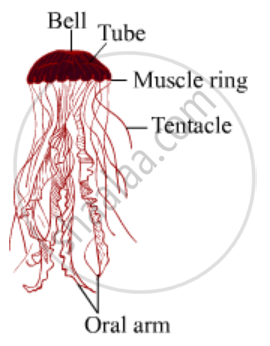
Draw a neat and labelled diagram.
Jellyfish
Advertisements
Solution
APPEARS IN
RELATED QUESTIONS
How useful is the study of the nature of body cavity and coelom in the classification of animals?
Distinguish between intracellular and extracellular digestion.
What is the difference between direct and indirect development?
Write the correct co-relation:
Annelida: Earthworm :: Platyhelminthes: _______
Label the body organization of human in the following figure:

The largest division of the living world is ______.
The symmetry exhibited in cnidarians is ______.
In Pheretima locomotion occurs with the help of ______.
Lateral line sense organs occur in ______.
Identify the structure that the archenteron becomes in a developing animal.
Observe the animal below and answer the following questions.

- Identify the animal.
- What type of symmetry does this animal exhibit?
- Is this animal Cephalized?
- How many germ layers does this animal have?
- How many openings does this animal’s digestive system have?
- Does this animal have neurons?
Which organism is called Friends of farmers? Why?
Identify the phylum in which adults exhibit radial symmetry and larva exhibit bilateral symmetry.
Which group of chordates possess sucking and circular mouth without jaws?
Differentiate between open circulatory system and closed circulatory system
Complete the paragraph using proper words:
(Asymmetrical, Paramecium, Equal, imaginary, central, insects, rats, bird, three, unequal)
If body of any animal is cut through ______ axis of body, it may or may not produce two equal halves. Depending upon this property, there are different types of animal bodies. In the case of ______ body, there is no any such imaginary axis of the body through which we can get two equal halves. For example Amoeba, ______ some sponges. In radial symmetry type of body, if imaginary cut passes through central axis but any plane of body, it gives two ______ halves. For example Starfish. In case of this animal, there are five different planes passing through ______ axis of body through which we can get two equal halves. In Bilateral symmetry type of body, there is only one such imaginary axis of body through which we can get two equal halves. For example: ______ fishes, frog, birds, human, etc.
