Advertisements
Advertisements
प्रश्न
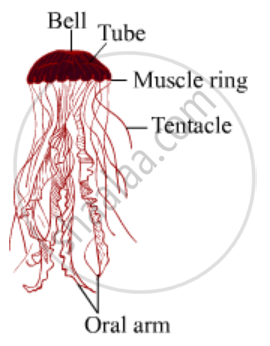
Draw a neat and labelled diagram.
Jellyfish
Advertisements
उत्तर
APPEARS IN
संबंधित प्रश्न
If you are given a specimen, what are the steps that you would follow to classify it?
How useful is the study of the nature of body cavity and coelom in the classification of animals?
Distinguish between intracellular and extracellular digestion.
What are the reasons that you can think of for the arthropods to constitute the largest group of the animal kingdom?
What is the exact difference between grades of organization and symmetry? Explain with examples.
The following characteristics are essential for classification.
Which of the following animals has a true coelom?
Match the following columns and select the correct option.
| Column – I | Column – II | ||
| (p) | Pila | (i) | Devil fish |
| (q) | Dentalium | (ii) | Chiton |
| (r) | Chaetopleura | (iii) | Apple snail |
| (s) | Octopus | (iv) | Tusk shell |
Compare Schizocoelom with enterocoelom.
Choose the term that does not belong in the following group and explain why it does not belong?
Notochord, cephalisation, dorsal nerve cord and radial symmetry.
______ was a greek philosopher who classified animals.
______ is a fluid-filled body cavity.
Which organism is called Friends of farmers? Why?
Identify the phylum in which adults exhibit radial symmetry and larva exhibit bilateral symmetry.
Which group of chordates possess sucking and circular mouth without jaws?
Provide appropriate technical term in the space provided.
Blood-filled cavity in arthropods ______.
Sort out the animals on the basis of their symmetry (radial or bilateral) coelenterates, ctenophores, annelids, arthropods, and echinoderms.
Complete the paragraph using proper words:
(Asymmetrical, Paramecium, Equal, imaginary, central, insects, rats, bird, three, unequal)
If body of any animal is cut through ______ axis of body, it may or may not produce two equal halves. Depending upon this property, there are different types of animal bodies. In the case of ______ body, there is no any such imaginary axis of the body through which we can get two equal halves. For example Amoeba, ______ some sponges. In radial symmetry type of body, if imaginary cut passes through central axis but any plane of body, it gives two ______ halves. For example Starfish. In case of this animal, there are five different planes passing through ______ axis of body through which we can get two equal halves. In Bilateral symmetry type of body, there is only one such imaginary axis of body through which we can get two equal halves. For example: ______ fishes, frog, birds, human, etc.
