Advertisements
Advertisements
प्रश्न
Draw a neat and labelled diagram.
Jellyfish
Advertisements
उत्तर
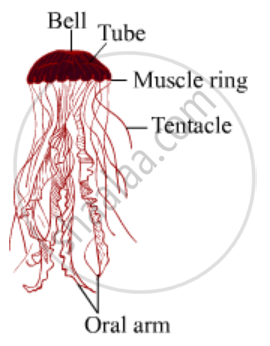
APPEARS IN
संबंधित प्रश्न
How useful is the study of the nature of body cavity and coelom in the classification of animals?
Distinguish between intracellular and extracellular digestion.
What is the difference between direct and indirect development?
What are the reasons that you can think of for the arthropods to constitute the largest group of the animal kingdom?
Write the correct co-relation:
Annelida: Earthworm :: Platyhelminthes: _______
The following characteristics are essential for classification.
The largest division of the living world is ______.
Species is the ______ unit of classification.
The symmetry exhibited in cnidarians is ______.
In Pheretima locomotion occurs with the help of ______.
Match the following columns and select the correct option.
| Column – I | Column – II | ||
| (p) | Pila | (i) | Devil fish |
| (q) | Dentalium | (ii) | Chiton |
| (r) | Chaetopleura | (iii) | Apple snail |
| (s) | Octopus | (iv) | Tusk shell |
Compare Schizocoelom with enterocoelom.
Identify the structure that the archenteron becomes in a developing animal.
Which organism is called Friends of farmers? Why?
Examine the figures of diploblastic (i) and triploblastic (ii) organization in animals given below and identify the labelled parts A to D.

What is the relationship between germinal layers and the formation of body cavity in case of coelomate, acoelomates and pseudocoelomates?
Animal with bilateral symmetry in ______.
