Advertisements
Advertisements
Question
Discuss the following topic in groups.
Freedom is life. Discuss this with reference to ‘Chandni’ and ‘I Want Something in a Cage’.
Advertisements
Solution
It is indeed very much true that slavery is a virtual death. Chandni, the goat, expressed her love for freedom by sacrificing her life. She fought a wolf boldly. In the story I want something in a, cage, this love for freedom is expressed through a prisoner who spends all he had in order to buy freedom for a pair of birds. Both
RELATED QUESTIONS
What happens when the zip on his carry-on bag gives way?
Why does the disciple’s decide to stay in the Kingdom of Fools? Is it a good idea?
Answer these question in one or two sentences . (The paragraph numbers within brackets provide clues to the answer.)
Why was Santosh sent to the local school?
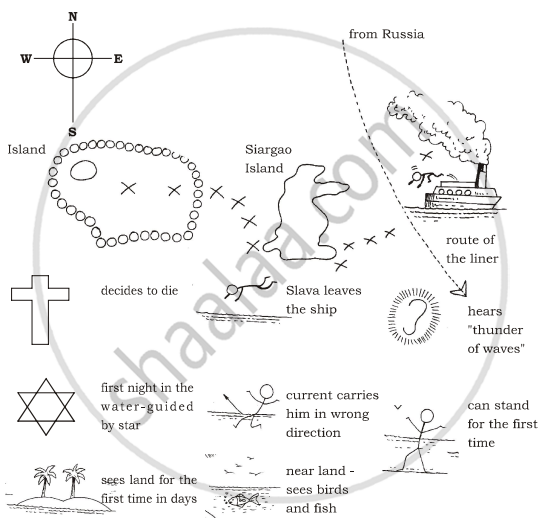
Given below is a map of the area in which Slava Kurilov faced his ordeal. You will also see the major events in the story, in mixed order, each accompanied by a symbol. After you have read ‘Ordeal in the Ocean’, draw the appropriate symbol against each x mark. (One is already drawn for you.) Draw the symbols or number the symbols, and transfer them to the map.)
We will ponder your proposition and when we decide we will let you know. But should we accept it, I here and now make this condition that we will not be denied the privilege without molestation of visiting at any time the tombs of our ancestors, friends, and children. Every part of this soil is sacred in the estimation of my people. Every hillside, every valley, every plain and grove, has been hallowed by some sad or happy event in days long vanished. Even the rocks, which seem to be dumb and dead as the swelter in the sun along the silent shore, thrill with memories of stirring events connected with the lives of my people, and the very dust upon which you now stand responds more lovingly to their footsteps than yours, because it is rich with the blood of our ancestors, and our bare feet are conscious of the sympathetic touch. Our departed braves, fond mothers, glad, happy hearted maidens, and even the little children who lived here and rejoiced here for a brief season, will love these somber solitudes and at eventide they greet shadowy returning spirits. And when the last Red Man shall have perished, and the memory of my tribe shall have become a myth among the White Men, these shores will swarm with the invisible dead of my tribe^ and when your children’s children think themselves alone in the field, the store, the shop, upon the highway, or in the silence of the pathless woods, they will not be alone. In all the earth there is no place dedicated to solitude. At night when the streets of your cities and villages are silent and you think them deserted, they will throng with the returning hosts’that once filled them and still lover this beautiful land. The White Man will never be alone.
Let him be just and deal kindly with my people, for the dead are not powerless. Dead, did I say? There is no death, only a change of worlds.
Read the extract given below and answer the question that follow.
What does the speaker say about death? Explain.
It was my business to cross the bridge, explore the bridge head 3 beyond and find out to what point the enemy had advanced. I did this and returned over the bridge. There were not so many carts now and very few people on foot, but the old man was still there.’’Where do you come from?” I asked him.
“From San Carlos,” he said, and smiled.
That was his native town and so it gave him pleasure to mention it and he smiled.
“I was taking care of animals,” he explained.
“Oh,” I said, not quite understanding.
“Yes,” he said, “I stayed, you see, taking care of animals. I was the last one to leave the town of San Carlos.”
He did not look like a shepherd nor a herdsman and I looked at his black dusty clothes and his gray dusty face and his steel rimmed spectacles and said, “What animals were they?”
“Various animals,” he said, and shook his head. “I had to leave them.”
Read the extract given below and answer the question that follow.
What gave the old man pleasure?
She again rubbed a match on the wall, and the light shone round her; in the brightness stood her old grandmother, clear and shining, yet mild and loving in her appearance. “Grandmother,” cried the little one, “O take me with you; I know you will go away when the match burns out; you will vanish like the warm stove, the roast goose, and the large, glorious Christmas-tree.” And she made haste to light the whole bundle of matches, for she wished to keep her grandmother there. And the matches glowed with a light that was brighter than the noon-day, and her grandmother had never appeared so large or so beautiful. She took the little girl in her arms, and they both flew upwards in brightness and joy far above the earth, where there was neither cold nor hunger nor pain, for they were with God.
In the dawn of morning there lay the poor little one, with pale cheeks and smiling mouth, leaning against the wall; she had been frozen to death on the last evening of the year; and the New-year’s sun rose and shone upon a little corpse! The child still sat, in the stiffness of death, holding the matches in her hand, one bundle of which was burnt. “She tried to warm herself,” said some. No one imagined what beautiful things she had seen, nor into what glory she had entered with her grandmother, on New-year’s day.
Read the extract given below and answer the question that follow.
Why was there a smile on the girl’s lips? Did the people understand?
Read the extract given below and answer the questions that follow:
Portia: To these injunctions every one doth s'vear
That comes to hazard for my worthless self.
Arragon: And so have I address'd me. Fortune now
To my heart's hope! - Gold, silver and base lead.
(i) Who had tried his luck in trying to choose the correct casket before the prince of Arragon? Which casket had that suitor chosen ? What did he find inside the casket?
(ii) What are the three things Arragon was obliged by the oath to obey?
(iii) What was the inscription on the golden casket? How do the actions of the martlet illustrate this inscription?
(iv) Which casket does Arragon finally choose? Whose portrait does he find inside? Which casket actually contains Portia's portrait?
(v) Who enters soon after? What does he say about the young Venetian who has just arrived? What gifts has the Venetian brought with him?
Answer the following question
Whom does Golu ask, “Why don’t you ever fly like other birds?”
Grandmother’s prophecy was that the tiger
Mark the right answer.
Read the following.
A group of children in your class are going to live in a hostel.
•They have been asked to choose a person in the group to share a room with.
•They are asking each other questions to decide who they would like to share a room with. Ask one another questions about likes/dislikes/preferences/hobbies/personal characteristics.
Use the following questions and sentence openings.
(i) What do you enjoy doing after school?
I enjoy...
(ii) What do you like in general?
I like...
(iii) Do you play any game?
I don’t like...
(iv) Would you mind if I listened to music after dinner?
I wouldn’t...
(v) Will it be all right if I...?
It’s fine with me...
(vi) Is there anything you dislike, particularly? Well, I can’t share...
(vii) Do you like to attend parties?
Oh, I...
(viii) Would you say you are...?
I think...
What did the beggar feel about the ladies of the household?
How fire is a good servant?
Why did the farmer bring a baby mongoose into the house?
Who visited the shepherd one day, and why?
Answer the following question:
How did she become an astronaut? What gave her the idea that she could be an astronaut?
Multiple Choice Question:
What does the word harvest mean?
What does he carry in his hand?
Read the lines given below and answer the following question:
| “But my darling, if you love me,” thought Miss Meadows, “I don’t Mind how much it is. Love me as little as you like.” |
What was the effect of Basil’s letter on Miss Meadows?
In the poem “Birches,” the poet observes that the birches are bent because ______.
