Advertisements
Advertisements
प्रश्न
Discuss the following topic in groups.
Freedom is life. Discuss this with reference to ‘Chandni’ and ‘I Want Something in a Cage’.
Advertisements
उत्तर
It is indeed very much true that slavery is a virtual death. Chandni, the goat, expressed her love for freedom by sacrificing her life. She fought a wolf boldly. In the story I want something in a, cage, this love for freedom is expressed through a prisoner who spends all he had in order to buy freedom for a pair of birds. Both
संबंधित प्रश्न
Use suitable words or phrases from Column A above to complete the paragraph given below.
A Traffic Jam
During power cuts, when traffic lights go off, there is utter ____ at crossroads. Drivers add
to the confusion by ____ over their right of way, and nearly come to blows. Sometimes
passers-by, seeing a few policemen ____ at regulating traffic, step in to help. This gives
them a feeling of having ____ something.
Match the phrases in Column A with their meanings in Column B.
| A | B | ||
| (i) | broke out | (a) | an attitude of kindness, a readiness to give freely |
| (ii) |
in accordance with |
(b) | was not able to tolerate |
| (iii) | a helping hand | (c) | began suddenly in a violent way |
| (iv) | could not stomach | (d) | assistance |
| (v) | generosity of spirit | (e) | persons with power to make decisions |
| (vi) | figures of authority | (f) | according to a particular rule, principle, or system |
Bill Bryson says, “I am, in short, easily confused.” What examples has he given to justify this?
On the basis of your understanding of the poem, answer the following question
by ticking the correct choice.
'The Solitary Reaper' is a narrative poem set to music. This form of verse is called
a______.
Some are meet for a maiden's wrist,
Silver and blue as the mountain mist,
Some are flushed like the buds that dream
On the tranquil brow of a woodland stream,
Some are aglow with the bloom that cleaves
To the limpid glory of new born leaves
Read the lines given above and answer the question that follow.
What stage of women’s life is referred to in this stanza?
The women came out on the shore, and made for the stepping—?stones. They had plenty to laugh and bicker about, as they approached the river in a noisy crowd. They girded up their skirts, so as to jump from stone to stone, and they clanked their sickles and forks together over their shoulders to have ease of movement. They shouted their quarrels above the gush of the river. Noise frightens crocodiles. The big mugger did not move, and all the women crossed in safety to the other bank. Here they had to climb a steep hillside to get at the grass, but all fell to with a will, and sliced away at it wherever there was foothold to be had. Down below them ran the broad river, pouring powerfully out from its deep narrow pools among the cold cliffs and shadows, spreading into warm shallows, lit by kingfishers. Great turtles lived there, and mahseer weighing more than a hundred pounds. Crocodiles too. Sometimes you could see them lying out on those slabs of clay over there, but there were none to be seen at the moment.
Read the extract given below and answer the question that follow.
What did the women carry?
Then there it lay in her wet palm, perfect, even pierced ready for use, with the sunset shuffled about inside it like gold—?dust. All her heart went up in flames of joy. After a bit she twisted it into the top of her skirt against her tummy so she would know if it burst through the poor cloth and fell. Then she picked up her fork and sickle and the heavy grass and set off home. Ai! Ai! What a day! Her barefeet smudged out the wriggle— ?mark of snakes in the dust; there was the thin singing of malaria mosquitoes among the trees now; and this track was much used at night by a morose old makna elephant—the Tuskless One; but Sibia was not thinking of any of them. The stars came out: she did not notice. On the way back she met her mother, out of breath, come to look for her, and scolding. “I did not see till I was home, that you were not there. I thought something must have happened to you.” And Sibia, bursting with her story, cried “Something did). I found a blue bead for my necklace, look!”
Read the extract given below and answer the question that follow.
Why did Sibia not tell her mother about her fight with the crocodile or how she saved the woman?
Answer the following question.
If the rebel has a dog for a pet, what is everyone else likely to have?
Why the early man was afraid of fire?
How did the two baby birds get separated?
Was the old woman’s gift to Vijay Singh eccentric? Why?
Was he successful in saving the cat the second time?
What is the butterfly busy doing?
What lesson does the young child narrator learn from his mother?
How did Patrick get his wish granted by the elf?
Complete the following sentence.
The small gray squirrel became friendly when _________
Multiple Choice Question:
What is the child curious about?
Look at the following picture. One asks a question, the other answers it. Then the answer is noted in a form as shown below.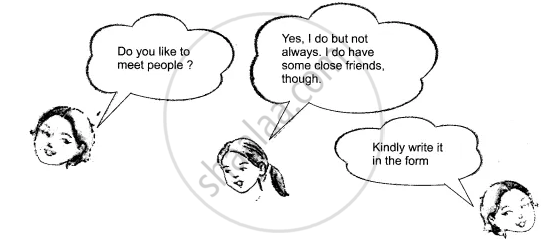
| Questions | Yes/No | Additional Response |
|
1. Do you like to meet people? |
Yes I do, but not always | I do have some close friends, though. |
|
2. Do you like the area you live in? |
No, I Don't | But I have no choice |
The words given against the sentences below can be used both as nouns and verbs. Use them appropriately to fill in the blanks.
(i) The boys put up a good athletic____________________________ . (show)
(ii) The soldiers ________________________ great courage in saving people from floods.
The words helper, companion, partner and accomplice have very similar meanings, but each word is typically used in certain phrases. Can you fill in the blanks below with the most commonly used words? A dictionary may help you.
my ……………. on the journey.
