Advertisements
Advertisements
प्रश्न
The words helper, companion, partner and accomplice have very similar meanings, but each word is typically used in certain phrases. Can you fill in the blanks below with the most commonly used words? A dictionary may help you.
I’m mother’s little ………………
पर्याय
helper
companion
partner
accomplice
Advertisements
उत्तर
I’m mother’s little helper.
संबंधित प्रश्न
Expressions used to show fear
Can you find the expressions in the story that tell you that the author was frightened?
Read the story and complete the following sentences.
1. I was turned ______.
2. I sat there holding ______.
3. In the light of the lamp I sat there like ______.
What does the swallow see when it flies over the city?
On the basis of your understanding of the poem, answer the following questions
by ticking the correct choice.
The setting of the poem is ___________.
Based on your reading of the passage, complete the statements using given connectors.
(a) The mother, father ______ thought ______ (and)
(b) They planned to walk to the woods ______ (which)
(c) They reached the place ______ in eighteen months (which)
(d) They eagerly unpacked their picnic basket ______ (but)
(e) It was ______, when the three tortoises arrived at the picnic place, (after)
(f) The mother tortoise ordered the baby to go home for the opener, saying ______ (that).
(g) ______ (but) was not willing at first.
(h) The mother and father promised to wait ______ (until)
(i) ______ they began to get very hungry, (after)
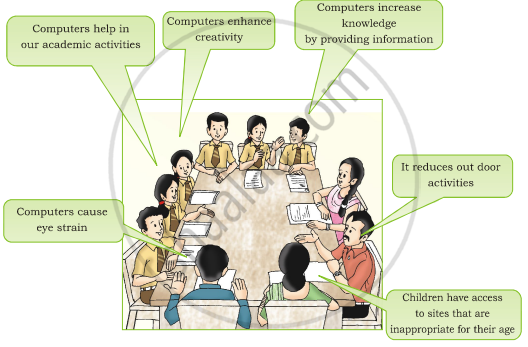
This is a meeting of the school’s Parent-Teacher Association. Some student representatives have also been invited to participate to discuss the role that Information technology/computers play in the growth and development of children.
What does he plant who plants a tree?
He plants cool shade and tender rain,
And seed and bud of days to be,
And years that fade and flush again;
He plants the glory of the plain;
He plants the forest's heritage;
The harvest of a coming age;
The joy that unborn eyes shall see___
These things he plants who plants a tree.
Read the lines given above and answer the question that follow:
Who is being referred to as the unborn eyes?
"My father lived at Blenheim then,
Yon little stream hard by;
They burnt his dwelling to the ground,
And he was forced to fly;
So with his wife and child he fled,
Nor had he where to rest his head.
"With fire and sword the country round
Was wasted far and wide,
And many a childing mother then,
And new-born baby died;
But things like that, you know, must be
At every famous victory;
Read the lines given above and answer the question that follow.
Explain the lines:
“With fire and sword the country round
Was wasted far and wide,’
Lights were shining from every window, and there was a savoury smell of roast goose, for it was New-year’s eve—yes, she remembered that. In a corner, between two houses, one of which projected beyond the other, she sank down and huddled herself together. She had drawn her little feet under her, but she could not keep off the cold; and
she dared not go home, for she had sold no matches, and could not take home even a penny of money. Her father would certainly beat her; besides, it was almost as cold at home as here, for they had only the roof to cover them, through which the wind howled, although the largest holes had been stopped up with straw and rags. Her little hands were almost frozen with the cold. Ah! perhaps a burning match might be some good, if she could draw it from the bundle and strike it against the wall, just to warm her fingers. She drew one out—“scratch!” how it sputtered as it burnt! It gave a warm, bright light, like a little candle, as she held her hand over it. It was really a wonderful light. It seemed to the little girl that she was sitting by a large iron stove, with polished brass feet and a brass ornament. How the fire burned! and seemed so beautifully warm that the child stretched out her feet as if to warm them, when, lo! the flame of the match went out, the stove vanished, and she had only the remains of the half-burnt match in her hand.
Read the extract given below and answer the question that follow.
Describe her home.
Describe the stranger who came to the pet shop. What did he want?
Why was everyone in the Control Room greatly excited?
Who the author called the right person to shake the bicycle?
Which one of the following sums up the story best?
Why has sleep been called a wonder?
What does the poet call ‘buttercup’ as? Why?
Word in the box given below indicates a large number of… For example, ‘a herd of cows’ refers to many cows. Complete the following phrase with a suitable word from the box.
a _______________of wolves
Multiple Choice Question:
The kite rides over _____________
What are some of the notable features told about snakes in the lesson?
Who says this to whom and why?
“I can’t pay you a penny for the wretched beast you sold me.”
Put each of the following in the correct order. Then use them appropriately to fill in the blanks in the paragraph that follows. Use correct punctuation marks.
- English and Hindi/both/in/he writes
- and only / a few short stories/many books in English/in Hindi
- Is/my Hindi / than my English/much better
Ravi Kant is a writer and ………….. Of course, he is much happier writing in English than in Hindi. He has written …………….. . I find his books a little hard to understand ………………… .
Choose the option that lists the sequence of events in the correct order.
- When the rain stopped, they rushed outdoors, forgetting all about Margot in their eagerness to experience the warmth of the sun.
- The children carried the pleading and protesting Margot to the closet and locked her in.
- It was then that they realised with shame that Margot was still locked in the closet; they had deprived her of what she longed for the most-the sun.
- All too soon, the brief summer ended, and the children hurried indoors to escape the heavy rains.
