Advertisements
Advertisements
Question
Differentiate between a benign tumor and a malignant tumor.
Advertisements
Solution
| No. | Benign cancer | Malignant cancer |
| i. | It grows slowly. | The growth rate of this tumour is rapid. |
| ii. | The mortality rate is extremely low. | The mortality rate is comparatively high. |
| iii. | These cells remain restricted to the site of origin and do not spread to other parts of the body. | These cells spread from one organ to another via blood or lymph by metastasis. |
| iv. | They may become malignant. | They form secondary tumours. |
| v. | They are nonmalignant/noncancerous. | They are malignant/cancerous. |
| vi. | 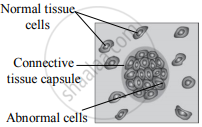 |
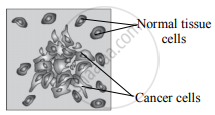 |
APPEARS IN
RELATED QUESTIONS
Explain the various types of cancer
Cancer is one of the most dreaded diseases. Explain 'Contact inhibition' and 'Metastasis' with respect to the disease
Why are cancer patients often given α-interferon as part of the treatment?
Give the symptoms of cancer.
Name one chemical carcinogen with its target tissue.
Carcinoma is cancer of ______ cells.
What is ‘Leukemia’?
Cancer cells are more easily damaged by radiations than normal cells because they are ______.
Which type of cancer affects lymph nodes and spleen?
Cancer of the epithelial cells is called ______.
Carcinogens are cancer causing agents.
Blood cancer is called ______.
Chemotherapy: Chemicals: Radiation therapy: ______.
Cancers of connective tissues are called ______.
Cancer is related to ______
Benign tumour is the one which
In malignant tumors, the cells proliferate, grow rapidly and move to other parts of the body to form new tumors. This stage of disease is called ______.
AIDS is caused by HIV. Among the following, which one is not a mode of transmission of HIV?
Give the full form of CT and MRI. How are they different from each other? Where are they used?
What is cancer? How is a cancer cell different from the normal cell? How do normal cells attain cancerous nature?
What are the methods of cancer detection? Describe the common approaches for treatment of cancer.
Genes involved in cancer are ______.
Which disease is caused by HPV?
Name any two techniques used to detect the cancer of internal organs and write about any one of them.
Immunotherapy these days is one of the most efficient ways of treatment of cancer. The therapy involved activates the immune system and destroys the tumour.
- Write an example of one such biological response modifier used in immunotherapy.
- Why do patients need such substances if immune system is already working in body?
- State what is 'Contact inhibition'.
What is a benign tumour?
During metastasis, where do cancer cells travel to form secondary tumours?
What is carcinoma?
What is lymphoma?
What is leukaemia?
Which of the following is a characteristic of benign tumours?
Which type of cancer would arise from bone tissue?
