Advertisements
Advertisements
प्रश्न
Differentiate between a benign tumor and a malignant tumor.
Advertisements
उत्तर
| No. | Benign cancer | Malignant cancer |
| i. | It grows slowly. | The growth rate of this tumour is rapid. |
| ii. | The mortality rate is extremely low. | The mortality rate is comparatively high. |
| iii. | These cells remain restricted to the site of origin and do not spread to other parts of the body. | These cells spread from one organ to another via blood or lymph by metastasis. |
| iv. | They may become malignant. | They form secondary tumours. |
| v. | They are nonmalignant/noncancerous. | They are malignant/cancerous. |
| vi. | 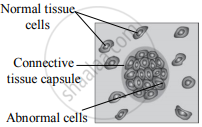 |
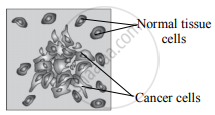 |
APPEARS IN
संबंधित प्रश्न
Why are cancer patients often given α-interferon as part of the treatment?
What is a carcinogen?
Name the main five types of cancer.
Carcinoma is cancer of ______ cells.
Inactive gene that can cause cancer is called ______.
antiviral proteins released by cells infected by the virus are called ______.
Cancer cells are more easily damaged by radiations than normal cells because they are ______.
Cancer of the epithelial cells is called ______.
Metastasis is associated with ______.
In leukemia both WBCs and RBCs increase in number.
Carcinogens are cancer causing agents.
Blood cancer is called ______.
Chemotherapy: Chemicals: Radiation therapy: ______.
How is a cancer cell different from a normal cell?
Cancers of connective tissues are called ______.
Stomach cancer is characterised as ______.
One of the following is INCORRECT about cancer cells.
Cancer is related to ______
Benign tumour is the one which
Cancer causing genes are called ______.
In malignant tumors, the cells proliferate, grow rapidly and move to other parts of the body to form new tumors. This stage of disease is called ______.
The immune system of a person is suppressed. In the ELISA test, he was found positive to a pathogen.
- Name the disease the patient is suffering from.
- What is the causative organism?
- Which cells of body are affected by the pathogen?
In the given flow diagram, the replication of retrovirus in a host is shown. Observe and answer the following questions.
Fill in (1) and (2)
Why is the virus called retrovirus?
Can the infected cell survive while viruses are being replicated and released?

What are the methods of cancer detection? Describe the common approaches for treatment of cancer.
Which disease is caused by HPV?
The interferons are ______.
Treatment of cancer by X-rays or gamma rays is ______.
Why is a malignant tumour considered to be more damaging than a benign tumour? Explain.
Immunotherapy these days is one of the most efficient ways of treatment of cancer. The therapy involved activates the immune system and destroys the tumour.
- Write an example of one such biological response modifier used in immunotherapy.
- Why do patients need such substances if immune system is already working in body?
- State what is 'Contact inhibition'.
Cells of malignant tumor spread from one organ to other via blood or lymph and cause new tumor. This property is called ______.
What is a benign tumour?
What is a malignant tumour?
What is metastasis?
What is leukaemia?
Which of the following is a characteristic of benign tumours?
Which of the following is a characteristic of malignant tumours?
