Advertisements
Advertisements
Question
Describe briefly an experiment to prove that vibrating bodies produce sound.
Advertisements
Solution
Experiment: Take a tuning fork. It is a U-shaped fork made of steel provided with a handle.

Strike the tuning fork with a rubber hammer and hold it close to ear. A sound is heard. Now take a freely suspended pith ball and touch one end of the tuning fork (which is already hit with a rubber hammer) to it. It is observed that pith ball repeatedly flies outward. This experiment too proves that sound is produced by a vibrating body.
APPEARS IN
RELATED QUESTIONS
What is loudness of sound? What factors does it depend on?
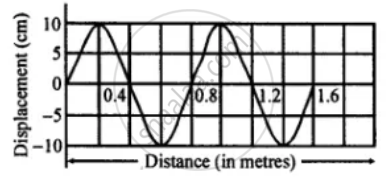
The diagram given below shows a displacement distance graph of a wave. If the velocity of wave is 160 ms-1, calculate:
- wavelength
- frequency
- amplitude.
Match the following.
| Ultrasonics | Frequency below 20Hz |
| Speed of sound in air | Needs material medium |
| Infrasonics | 330ms-1 |
| Sound propagation | Frequency more than 20000 Hz |
Which of the following statements are correct?
- Sound is produced by vibrations.
- Sound requires a medium for propagation.
- Light and sound both require a medium for propagation.
- Sound travels slower than light.
Longitudinal waves are produced in solids liquids and also in gases.
The speed of sound in air at 0°C is ______.
Assertion: The sound of thunder is heard a little later than the flash of light.
Reason: The speed of sound is much less than the speed of light.
How do we hear the sound?
