Advertisements
Advertisements
Question
State three conditions necessary for hearing sound.
Advertisements
Solution
Necessary conditions for hearing a sound:
- There must be a vibrating body, capable of transferring its energy to its surroundings.
- These must be a material medium to pick the energy and then propagate it in a forward direction.
- There must be a receiver, so as to receive the sound vibrations and then transmit them to the brain for final interpretation, such as the human ear.
APPEARS IN
RELATED QUESTIONS
What are wavelength, frequency, time period and amplitude of a sound wave?
Describe an experiment to show the production of sound having low and high pitch.
In an experiment, Anhad studies sound waves. He sets up a loudspeaker to produce sound as shown below :
Anhad adjusts the signal to the loudspeaker to give a sound of frequency 200 Hz.
(a) What happens to the air in-between Anhad and the loudspeaker ?
(b) Explain how Anhad receives sound in both ears.
A cannon is fired at A (see diagram). An observer at B hears two sounds. The first sound is heard after 1 second and the second 3s after the observer sees the flash. (Velocity of sound = 340 ms−1)
(i) Why does the observer see the flash before he hears the sound?
(ii) Calculate the distance x between the observer and the wall.
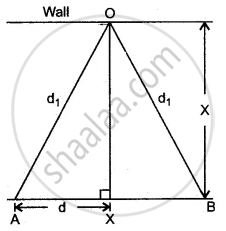
Give an example to show that light travels faster than sound?
Sound is a ______ wave and needs a material medium to travel.
Describe with diagram, how compressions and rarefactions are produced.
The sound waves are reflected from an obstacle into the same medium from which they were incident. Which of the following changes?
Draw a curve showing density or pressure variations with respect to distance for a disturbance produced by sound. Mark the position of compression and rarefaction on this curve. Also, define wavelengths and time periods using this curve.
Unwanted sounds are called ______.
