Advertisements
Advertisements
Question
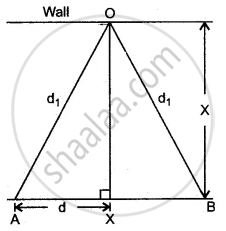
A cannon is fired at A (see diagram). An observer at B hears two sounds. The first sound is heard after 1 second and the second 3s after the observer sees the flash. (Velocity of sound = 340 ms−1)
(i) Why does the observer see the flash before he hears the sound?
(ii) Calculate the distance x between the observer and the wall.
Advertisements
Solution
(i) An observer sees the flash first and hears the sound afterward because the velocity of light which is equal to 3 × 10⁸ ms−1 is much higher than the velocity of sound which is 340 ms−1.
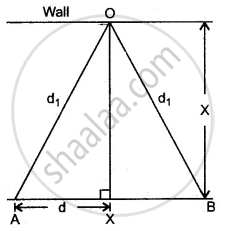
(ii) v = `(3"d"_1)/"t"`
An echo or the second sound is heard after 3s.
∴ t = 3s
∴ 340 = `(3"d"_1)/3`
∴ d1 = `(340xx3)/2`
= 510 ms−1
In right Δ AOX: d12 = OX2 + d2 = x2 + d2
∴ d12 − d2 = x2 ................(i)
but 2d = v × t .............(where t = 1s)
2d = 340 ..........(v = 340 ms−1 and t = 1s)
∴ d = 170 m ....................(ii)
From equation (i) and (ii),
x = (510)2 − (170)2 = `10sqrt2312`
∴ x = 481 m
The distance between the observer and the well is 481 m.
RELATED QUESTIONS
How does the loudness of sound produced depend on the vibrating area of the body ?
How does a man’s voice differ from a woman’s voice ?
What are wavelength, frequency, time period and amplitude of a sound wave?
What is the nature of sound waves in air?
How does the speed of sound depend on (i) Amplitude, and (ii) Wavelength?
How do the following factor affect the speed of sound in air?
Moisture in air.
A person fires a gun and other boy at a distance hears the sound of the fire 2.5 s after seeing the flash. If the speed of sound in air is 330 ms-1, find the distance between the boys.
Waves created by Earth Quake are Infrasonic.
Match the following
| 1. | Infrasonic | (a) | Compressions |
| 2. | Echo | (b) | 22 kHz |
| 3. | Ultrasonic | (c) | 10 Hz |
| 4. | High-pressure region | (d) | Ultrasonography |
