Advertisements
Advertisements
प्रश्न
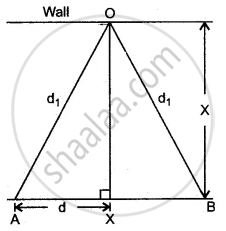
A cannon is fired at A (see diagram). An observer at B hears two sounds. The first sound is heard after 1 second and the second 3s after the observer sees the flash. (Velocity of sound = 340 ms−1)
(i) Why does the observer see the flash before he hears the sound?
(ii) Calculate the distance x between the observer and the wall.
Advertisements
उत्तर
(i) An observer sees the flash first and hears the sound afterward because the velocity of light which is equal to 3 × 10⁸ ms−1 is much higher than the velocity of sound which is 340 ms−1.
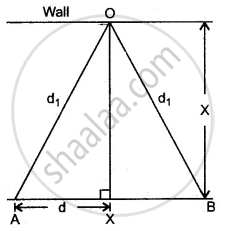
(ii) v = `(3"d"_1)/"t"`
An echo or the second sound is heard after 3s.
∴ t = 3s
∴ 340 = `(3"d"_1)/3`
∴ d1 = `(340xx3)/2`
= 510 ms−1
In right Δ AOX: d12 = OX2 + d2 = x2 + d2
∴ d12 − d2 = x2 ................(i)
but 2d = v × t .............(where t = 1s)
2d = 340 ..........(v = 340 ms−1 and t = 1s)
∴ d = 170 m ....................(ii)
From equation (i) and (ii),
x = (510)2 − (170)2 = `10sqrt2312`
∴ x = 481 m
The distance between the observer and the well is 481 m.
संबंधित प्रश्न
Calculate the wavelength of a sound wave whose frequency is 220 Hz and speed is 440 m/s in a given medium.
How do we produce sound ?
Draw a graph between displacement from mean position and time for a body executing free vibrations in vacuum.
A source of wave produces 40 crests and 40 troughs in 0.4 s. What is the frequency of the wave?
Arrange the speeds of sound in gases, solids, and liquids in ascending order.
What is approximate value of the speed of sound in iron as compared to that in air? Illustrate your answer with a simple experiment.
A sound wave of wavelength 1/3 m has a frequency 996 Hz. Keeping the medium same, if frequency changes to 1328 Hz. Calculate
- velcoity of sound
- new wavelength.
Number of vibrations produced in one second is ______.
Waves created by Earth Quake are Infrasonic.
Write any two uses of ultrasonic sound.
