Advertisements
Advertisements
प्रश्न
What are longitudinal waves and transverse waves? Explain with the help of labelled diagrams.
Advertisements
उत्तर
Longitudinal waves: These are the waves in which medium particles vibrate to and fro in the direction of propagation of the wave. This type of wave can be formed in solid, liquid, and gas.
Example: Sound waves.
Transverse waves: These are the waves in which medium particles vibrate perpendicular to the direction of propagation of wave. This type of wave can be formed only in solid and liquid.
Example: Ripples in water.
APPEARS IN
संबंधित प्रश्न
Write true or false for a given statement.
Sound can only be produced by vibrating bodies.
Write true or false for a given statement.
Loudness depends on frequency.
Select the correct alternative :
We can hear sound of frequency
Describe an experiment to show the production of sound having low and high pitch.
Draw a graph between displacement from mean position and time for a body executing free vibrations in vacuum.
What type of waves are illustrated by the movement of a rope whose one end is fixed to a pole and the other end is moved up and down?
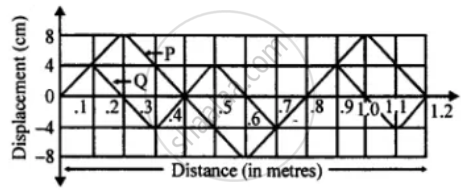
From diagram given below calculate:
- velocity of P and Q
- frequency of P, when frequency of Q is 512 Hz.
Assume that both wave are traveling in same medium.
The sound produced by a thunderstorm is heard 10 s after the lightning is seen. Calculate the approximate distance of the thunder cloud. (Given the speed of sound = 340 m s–1.)
Why is the ceiling and wall behind the stage of good conference halls or concert halls made curved?
