Advertisements
Advertisements
प्रश्न
Give two examples each of longitudinal waves and transverse waves.
Advertisements
उत्तर
Examples of longitudinal waves are:
(i) The waves that travel along a spring when it is pushed and pulled at one end.
(ii) Sound waves in air.
Examples of transverse waves are:
(i) The waves produced by moving one end of a long spring up and down rapidly while the other end is fixed.
(ii) The water waves (or ripples) formed on the surface of water in a pond by throwing a stone in it.
APPEARS IN
संबंधित प्रश्न
Fill in the blank.
The pitch of a sound depends on its ________.
What is sound ?
State the general name of the waves in which the particles of the medium vibrate :
(i) in the same direction as wave.
(ii) at right angles to the direction of wave.
What is the nature of sound waves in air?
The speed of sound is more in hydrogen than in nitrogen. Is this statement true? Give a reason for your answer.
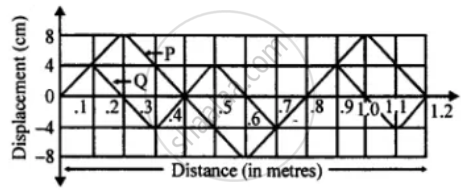
From diagram given below calculate:
- velocity of P and Q
- frequency of P, when frequency of Q is 512 Hz.
Assume that both wave are traveling in same medium.
Sound is a ______ wave and needs a material medium to travel.
How does the sound produced by a vibrating object in a medium reach your ears?
Why is the ceiling and wall behind the stage of good conference halls or concert halls made curved?
Longitudinal waves are produced in solids liquids and also in gases.
