Advertisements
Advertisements
प्रश्न
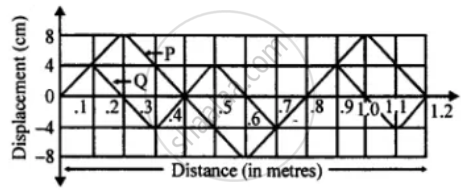
From diagram given below calculate:
- velocity of P and Q
- frequency of P, when frequency of Q is 512 Hz.
Assume that both wave are traveling in same medium.
Advertisements
उत्तर
For Q:
Wavelength (λ) = Distance between two consecutive crests
= 0.5 - 0.1 = 0.4 m
Frequency(f) = 515 Hz
Velocity(v) = λf
= 0.4 × 512 = 204.8 ms-1
Since both waves are travelling in same medium and velocity of P and Q is same i.e. 204.8 ms-1
For P:
Wavelength = λ' = 1.0 - 0.2 = 0.8 m
Velocity = v = 204.8 ms-1
Frequnecy of wave P = f' = ?
v = λ'f'
f = `"v"/(lambda') = 204.8/0.8 = 256` Hz
APPEARS IN
संबंधित प्रश्न
In an experiment, Anhad studies sound waves. He sets up a loudspeaker to produce sound as shown below :
Anhad adjusts the signal to the loudspeaker to give a sound of frequency 200 Hz.
(a) What happens to the air in-between Anhad and the loudspeaker ?
(b) Explain how Anhad receives sound in both ears.
Which of the following frequency of sound can be generated by a vibrating simple pendulum as well as by the vibrating vocal cords of a rhinoceros ?
What is the audible range of frequency for human?
What is the ratio of speed of light to speed of sound?
Define one hertz.
What is echolocation? How do animals make use of this phenomenon?
Vibration of object produces ______.
Why is the ceiling and wall behind the stage of good conference halls or concert halls made curved?
Name two musical instruments which produce sound by vibrating strings.
