Advertisements
Advertisements
प्रश्न
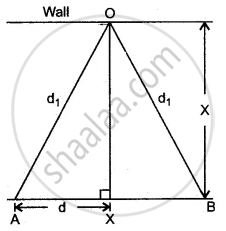
A cannon is fired at A (see diagram). An observer at B hears two sounds. The first sound is heard after 1 second and the second 3s after the observer sees the flash. (Velocity of sound = 340 ms−1)
(i) Why does the observer see the flash before he hears the sound?
(ii) Calculate the distance x between the observer and the wall.
Advertisements
उत्तर
(i) An observer sees the flash first and hears the sound afterward because the velocity of light which is equal to 3 × 10⁸ ms−1 is much higher than the velocity of sound which is 340 ms−1.
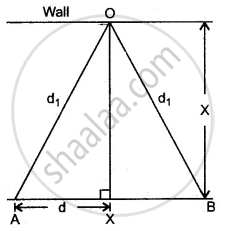
(ii) v = `(3"d"_1)/"t"`
An echo or the second sound is heard after 3s.
∴ t = 3s
∴ 340 = `(3"d"_1)/3`
∴ d1 = `(340xx3)/2`
= 510 ms−1
In right Δ AOX: d12 = OX2 + d2 = x2 + d2
∴ d12 − d2 = x2 ................(i)
but 2d = v × t .............(where t = 1s)
2d = 340 ..........(v = 340 ms−1 and t = 1s)
∴ d = 170 m ....................(ii)
From equation (i) and (ii),
x = (510)2 − (170)2 = `10sqrt2312`
∴ x = 481 m
The distance between the observer and the well is 481 m.
संबंधित प्रश्न
Write true or false for a given statement.
A sound is a form of energy.
Write true or false for a given statement.
Waveforms of two different stringed instruments can be the same.
Select the correct alternative :
We can distinguish a shrill sound from a flat sound by its
What is a longitudinal wave ?
What is the nature of sound waves in air?
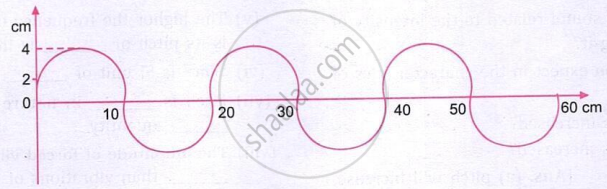
In fig. shows a snapshot of a wave from of frequency 50 Hz in a string. The numbers in the diagram represents distance in centimeters. For this wave motion, find
- wavelength
- amplitude
- velocity
Select the correct option:
The longitudinal waves can propagate only in
Select the correct option:
If the frequency of a wave is 25 Hz. the total number of compressions and rarefactions passing through a point in 1 second is :
The wavelength of the vibrations produced on the surface of water is 2 cm. If the wave velocity is 16 ms-1, calculate:
- no. of waves produced in one second
- time required to produce one wave.
Sound travels in air:
