Advertisements
Advertisements
Question
Define the term focus of a lens.
Advertisements
Solution
The focus of a lens (often called the principal focus) is a specific point on its principal axis where light rays parallel to the axis either converge or appear to originate from after passing through the lens.
APPEARS IN
RELATED QUESTIONS
In the following figure (a) and (b), F1 and F2 are positions of the two foci of thin lenses. Draw the path taken by the light ray AB after it emerges from each lens.
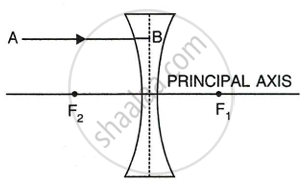 |
| (a) |
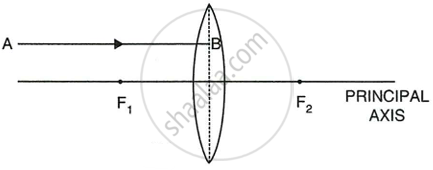 |
| (b) |
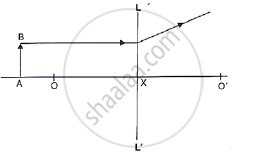
Study the diagram shown in Fig. 5.56
Complete the diagram to show the formation of image A’B’ of the object AB of same size.
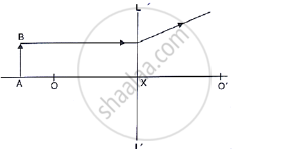
Study the diagram shown in the following Figure.
Name the lens LL’ and draw its outline.
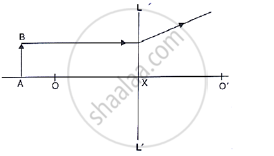
Study the diagram shown in Fig. 5.56
Where is the image formed?
(a) Draw a sketch to show how a lens is able to produce an image of the sun on a paper screen.
(b)(i) Would you regard the rays from the sun as being divergent, parallel or convergent?
(ii) What is the name given to the point where such rays meet after they have passed through the lens?
(iii) How does the image of the sun sometimes burn a paper screen?
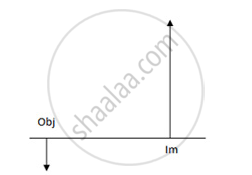
In the following diagram , the object and the image formed by the respective lenses are shown. Complete the ray diagram, and locate the focus. Find the focal length of the lens.
In fig., a real image of a point objert O is formed, Which of the following statements is true about each of the arrangements?
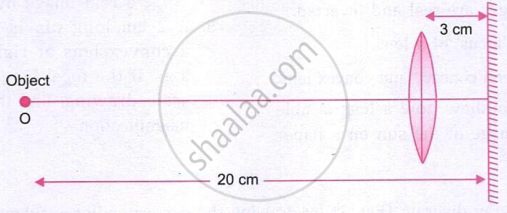
- The object is at the principle focus of the lens.
- The focal length of the lens is 17 cm.
- If the mirror is moved so that it is 6 cm from the lens image will also move.
A lens forms the image of an object placed at a distance of 45 cm from it on a screen placed at a distance 90 cm on the other side of it. Name the kind of lens.
Name the subjective property of light related to its wavelength.
Mixture of red + blue + green is passed through a convex lens as shown in the diagram below. State whether the ray passes through a single point or through different points on the principal axis after refraction.

