Advertisements
Advertisements
Question
A ray of light after refraction through a lens emerges parallel to the principal axis of the lens. The incident ray either passes through ______.
Options
its optical centre
its first focus
its second focus
its centre of curvature of the first surface
Advertisements
Solution
A ray of light after refraction through a lens emerges parallel to the principal axis of the lens. The incident ray either passes through its first focus.
APPEARS IN
RELATED QUESTIONS
Explain optical centre of a lens with the help of proper diagram(s).
State the condition when a lens is called an equi-convex or equi-concave.
Study the diagram shown in the following Figure.
Name the lens LL’ and draw its outline.
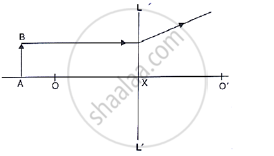
Study the diagram shown in Fig. 5.56
where is the object located?
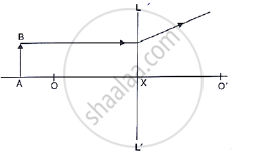
A ray of light incident parallel to the principal axis of a lens, passes undeviated after refraction.
A ray of light incident at the optical centre of lens, passes undeviated after refraction.
Fig shows an object PQ placed on the principle axis of a lens L. The two foci of the kens are F1 and f2. The image formed by the lens is erect, Virtual and dimnished.
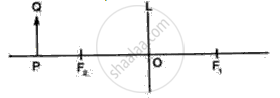
(i) Draw the outline ofthe lens L used and Named it.
(ii) Draw a ray of light starting from Q and passing through O. show the same ray after refraction by the lens.
(iii) Draw another ray from Q Which is incident parallel to the principle axis and show how it emerges after refraction from the lens.
(iv) Locate the final image formed.
In the following diagram , the object and the image formed by the respective lenses are shown. Complete the ray diagram, and locate the focus. Find the focal length of the lens.
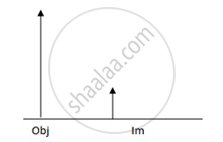
A lens used as a magnifying glass
- is a diverging lens
- produces a virtual image
- is placed with the object nearer the lens than the principal focus
Make the correct choices in the following items:
lf the image can be focused on a screen it must be
