Advertisements
Advertisements
Question
Define the following term:
Ferromagnetism
Advertisements
Solution
Ferromagnetism is defined as the phenomenon in which substances, such as iron, cobalt and nickel, are strongly attracted by a magnetic field. Such substances are called ferromagnetic substances.
RELATED QUESTIONS
What is ferromagnetism?
Write the type of magnetism observed when the magnetic moments are oppositely aligned and cancel out each other.
Write the type of magnetism observed when the magnetic moments are aligned in parallel and anti-parallel directions in unequal numbers.
What type of substances would make better permanent magnets, ferromagnetic or ferrimagnetic. Justify your answer.
Explain the following with suitable examples:
Paramagnetism
Explain the following with suitable examples:
Ferrimagnetism
The complexion [Ni(CN)4]2- is:
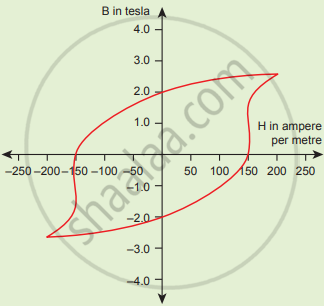
The BH curve for a ferromagnetic material is shown in the figure. The material is placed inside a long solenoid which contains 1000 turns/cm. The current that should be passed in the solenonid to demagnetize the ferromagnet completely is
What is magnetic susceptibility?
Give the properties of dia/para/ferromagnetic materials.
Example of ferromagnetic substance is ____________.
Substances which are weakly repelled in magnetic field are known as ____________.
All those atoms or molecules which have an odd number of electrons are
When heated to high temperature, ferromagnetic substance changes to ____________.
Fe3O4 is ____________.
Assertion: On heating ferromagnetic or ferrimagnetic substances, they become paramagnetic.
Reason: The electrons change their spin on heating.
Which of the following arrangements shows schematic alignment of magnetic moments of antiferromagnetic substances?
The value of magnetic moment is zero in the case of antiferromagnetic substances because the domains:
(i) get oriented in the direction of the applied magnetic field.
(ii) get oriented opposite to the direction of the applied magnetic field.
(iii) are oppositely oriented with respect to each other without the application of magnetic field.
(iv) cancel out each other’s magnetic moment.
Which of the following statements are correct?
(i) Ferrimagnetic substances lose ferrimagnetism on heating and become paramagnetic.
(ii) Ferrimagnetic substances do not lose ferrimagnetism on heating and remain ferrimagnetic.
(iii) Antiferromagnetic substances have domain structures similar to ferromagnetic substances and their magnetic moments are not cancelled by each other.
(iv) In ferromagnetic substances all the domains get oriented in the direction of magnetic field and remain as such even after removing magnetic field.
Which one of the following would feel attraction when placed in magnetic field: Co2+, Ag+, Ti4+, Zn2+
Which one of the following pairs has only paramagnetic species?
The heat of combustion of a substance is:
Which of the following is not a ferroelectric compound?
Some of the polar crystals when heated produces small electrical current. This phenomenon is called ______.
Given below are two statements labelled as Assertion (A) and Reason (R).
Assertion: Magnetic moment values of actinides are lesser than the theoretically predicted values.
Reason: Actinide elements are strongly paramagnetic.
Select the most appropriate answer from the options given below:
The susceptibility of a paramagnetic material is 99. The permeability of the material in Wb/A-m is ______.
[permeability of the free space μ0 = 4π × 10-7 Wb/A - m]
The value of aluminium susceptibility is 2.2 × 10⁻⁵. The percentage increase in the magnetic field if space within a current carrying toroid is filled with aluminium is `"x"/10^4`. Then the value of x is ______.
Which one of the following compounds is diamagnetic and colourless?
The calculated spin only magnetic moment of Cr2+ ion is ______.
