Advertisements
Advertisements
प्रश्न
Define the following term:
Ferromagnetism
Advertisements
उत्तर
Ferromagnetism is defined as the phenomenon in which substances, such as iron, cobalt and nickel, are strongly attracted by a magnetic field. Such substances are called ferromagnetic substances.
संबंधित प्रश्न
What is ferromagnetism?
Iron (z=26) is highly ferromagnetic. Explain.
Write the type of magnetism observed when the magnetic moments are aligned in parallel and anti-parallel directions in unequal numbers.
Explain the following with suitable examples:
Ferrimagnetism
Explain the following with suitable examples:
Antiferromagnetism
Give reasons:Ferrimagnetic substances show better magnetism than antiferromagnetic substances.
Explain why:
(i) Transition elements form coloured compounds.
(ii) Interhalogen compounds are more reactive than their constituent elements.
(iii) Cu+ is diamagnetic but Cu2+ is paramagnetic. (Z = 29)
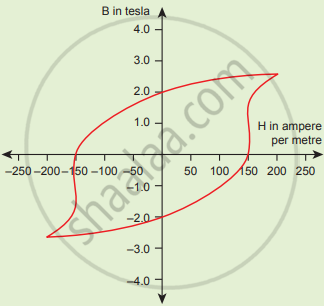
The BH curve for a ferromagnetic material is shown in the figure. The material is placed inside a long solenoid which contains 1000 turns/cm. The current that should be passed in the solenonid to demagnetize the ferromagnet completely is
Compare dia, para and ferromagnetism.
Give the properties of dia/para/ferromagnetic materials.
What happens to the domains in a ferromagnetic material in the presence of external magnetic field?
Substances which are weakly repelled in magnetic field are known as ____________.
When heated to high temperature, ferromagnetic substance changes to ____________.
Fe3O4 is ____________.
Which type of substances would make better permanent magnets?
Assertion: On heating ferromagnetic or ferrimagnetic substances, they become paramagnetic.
Reason: The electrons change their spin on heating.
Fe3O4 (magnetite) is an example of ___________.
Which of the following arrangements shows schematic alignment of magnetic moments of antiferromagnetic substances?
A ferromagnetic substance becomes a permanent magnet when it is placed in a magnetic field becuase ______.
Which one of the following would feel attraction when placed in magnetic field: Co2+, Ag+, Ti4+, Zn2+
The heat of combustion of a substance is:
Some of the polar crystals when heated produces small electrical current. This phenomenon is called ______.
Magnetic materials used for making permanent magnets (P) and magnets in a transformer (T) have different properties of the following, which property best matches for the type of magnet required ?
Which of the following statements are correct?
- Electric monopoles do not exist whereas magnetic monopoles exist.
- Magnetic field lines due to a solenoid at its ends and outside cannot be completely straight and confined.
- Magnetic field lines are completely confined within a toroid.
- Magnetic field lines inside a bar magnet are not parallel.
- χ = -1 is the condition for a perfect diamagnetic material, where x is its magnetic susceptibility.
The susceptibility of a paramagnetic material is 99. The permeability of the material in Wb/A-m is ______.
[permeability of the free space μ0 = 4π × 10-7 Wb/A - m]
The value of aluminium susceptibility is 2.2 × 10⁻⁵. The percentage increase in the magnetic field if space within a current carrying toroid is filled with aluminium is `"x"/10^4`. Then the value of x is ______.
Match items of List - I with those of List - II:
| List - I | List - II | ||
| (Property) | (Example) | ||
| (A) | Diamagnetism | (i) | MnO |
| (B) | Ferrimagnetism | (ii) | O2 |
| (C) | Paramagnetism | (iii) | NaCl |
| (D) | Antiferromagnetism | (iv) | Fe3O4 |
Choose the most appropriate answer from the options given below:
Which one of the following compounds is diamagnetic and colourless?
The calculated spin only magnetic moment of Cr2+ ion is ______.
