Advertisements
Advertisements
प्रश्न
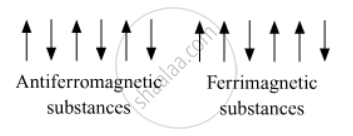
Give reasons:Ferrimagnetic substances show better magnetism than antiferromagnetic substances.
Why do ferrimagnetic substances show better magnetism than antiferromagnetic substances?
Advertisements
उत्तर १
In the presence of magnetic field, the magnetic moments of domains of an antiferromagnetic substances are ordered in such a way half of the magnetic moments are aligned in one direction while the remaining half are in opposite direction. As a result of it net magnetic moment will be zero whereas in case of ferrimagnetic substances the magnetic moments of the domains of ferrimagnetic substances are aligned in parallel and anti-parallel directions in unequal numbers. As a result, there will be small value of magnetic moment for ferrimagnetic substances.
उत्तर २
Anti-ferromagnetism have domain structures that are oppositely oriented and cancel out each other's magnetic moment while in ferrimagnetism the magnetic moments of the domains in the substance are aligned in parallel and anti-parallel directions in unequal numbers resulting net dipole moment. Hence, ferrimagnetic substances show better magnetism than antiferromagnetic substances.
APPEARS IN
संबंधित प्रश्न
Write the type of magnetism observed when the magnetic moments are oppositely aligned and cancel out each other.
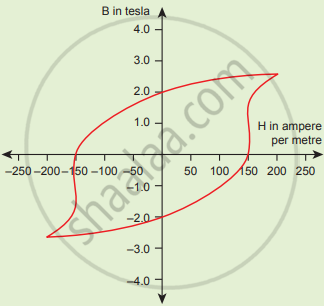
The BH curve for a ferromagnetic material is shown in the figure. The material is placed inside a long solenoid which contains 1000 turns/cm. The current that should be passed in the solenonid to demagnetize the ferromagnet completely is
All those atoms or molecules which have an odd number of electrons are
A ferromagnetic substance becomes a permanent magnet when it is placed in a magnetic field becuase ______.
The heat of combustion of a substance is:
Among the following ions, which one has the highest paramagnetism?
Match items of List - I with those of List - II:
| List - I | List - II | ||
| (Property) | (Example) | ||
| (A) | Diamagnetism | (i) | MnO |
| (B) | Ferrimagnetism | (ii) | O2 |
| (C) | Paramagnetism | (iii) | NaCl |
| (D) | Antiferromagnetism | (iv) | Fe3O4 |
Choose the most appropriate answer from the options given below:
Which one of the following compounds is diamagnetic and colourless?
The metal complex ion that is paramagnetic is ______.
(Atomic number of Fe = 26, Cu = 29, Co = 27 and Ni = 28)
The calculated spin only magnetic moment of Cr2+ ion is ______.
