Advertisements
Advertisements
Question
The metal complex ion that is paramagnetic is ______.
(Atomic number of Fe = 26, Cu = 29, Co = 27 and Ni = 28)
Options
[Fe(CN)4]2−
[Co(NH3)6]3+
[Ni(CN4)]2−
[Cu(NH3)4]2+
Advertisements
Solution
The metal complex ion that is paramagnetic is [Cu(NH3)4]2+.
Explanation:
Paramagnetic substances have unpaired electrons, while diamagnetic substances have all electrons paired
- [Fe(CN)4]2−
Assume x is the oxidation number of Fe in given complex.
x + 4(−1) = −2
x − 4 = − 2
x = − 2 + 4
= + 2
Electronic configuration of Fe = [Ar]3d64s2
Fe+2 = [Ar]3d6
All electrons are paired; hence, it is diamagnetic in nature [Co(NH3)6]3+ - Assume x is the oxidation number of Co in given complex.
x + 6(0) = + 3
x = + 3
Electronic configuration of Co = [Ar] 3d74s2
Co+3 = [Ar]3d6 - All electrons are paired; hence, it is diamagnetic [Ni(CN4)]2−
Assume x is the oxidation number of Ni in the given complex.
x + 4(−1) =− 2
x − 4 = − 2
x = + 2
Electronic configuration of Ni = [Ar] 3d84s2
Ni2+ = [Ar]3d8 - All electrons are paired, hence, it is diamagnetic [Cu(NH3)4]2+.
Assume x is the oxidation number of Cu in the given complex.
x + 4(0) = + 2
x = + 2
Electronic configuration of Cu = [Ar] 3d10 4s1
Cu−2 = [Ar]3d9
It has one unpaired electron; hence, it is paramagnetic.
APPEARS IN
RELATED QUESTIONS
What type of magnetism is shown in the following alignment of magnetic moments?

Write the type of magnetism observed when the magnetic moments are aligned in parallel and anti-parallel directions in unequal numbers.
Give reason for the following :
Sulphur in vapour state shows paramagnetic behaviour.
The BH curve for a ferromagnetic material is shown in the figure. The material is placed inside a long solenoid which contains 1000 turns/cm. The current that should be passed in the solenonid to demagnetize the ferromagnet completely is
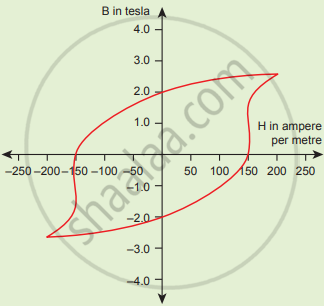
What happens to the domains in a ferromagnetic material in the presence of external magnetic field?
Assertion: On heating ferromagnetic or ferrimagnetic substances, they become paramagnetic.
Reason: The electrons change their spin on heating.
Which of the following is not a ferroelectric compound?
Given below are two statements labelled as Assertion (A) and Reason (R).
Assertion: Magnetic moment values of actinides are lesser than the theoretically predicted values.
Reason: Actinide elements are strongly paramagnetic.
Select the most appropriate answer from the options given below:
Give a reason for the following:
Cu+2 salts are paramagnetic, while Cu+ salts are diamagnetic.
The calculated spin only magnetic moment of Cr2+ ion is ______.
