Advertisements
Advertisements
प्रश्न
The metal complex ion that is paramagnetic is ______.
(Atomic number of Fe = 26, Cu = 29, Co = 27 and Ni = 28)
पर्याय
[Fe(CN)4]2−
[Co(NH3)6]3+
[Ni(CN4)]2−
[Cu(NH3)4]2+
Advertisements
उत्तर
The metal complex ion that is paramagnetic is [Cu(NH3)4]2+.
Explanation:
Paramagnetic substances have unpaired electrons, while diamagnetic substances have all electrons paired
- [Fe(CN)4]2−
Assume x is the oxidation number of Fe in given complex.
x + 4(−1) = −2
x − 4 = − 2
x = − 2 + 4
= + 2
Electronic configuration of Fe = [Ar]3d64s2
Fe+2 = [Ar]3d6
All electrons are paired; hence, it is diamagnetic in nature [Co(NH3)6]3+ - Assume x is the oxidation number of Co in given complex.
x + 6(0) = + 3
x = + 3
Electronic configuration of Co = [Ar] 3d74s2
Co+3 = [Ar]3d6 - All electrons are paired; hence, it is diamagnetic [Ni(CN4)]2−
Assume x is the oxidation number of Ni in the given complex.
x + 4(−1) =− 2
x − 4 = − 2
x = + 2
Electronic configuration of Ni = [Ar] 3d84s2
Ni2+ = [Ar]3d8 - All electrons are paired, hence, it is diamagnetic [Cu(NH3)4]2+.
Assume x is the oxidation number of Cu in the given complex.
x + 4(0) = + 2
x = + 2
Electronic configuration of Cu = [Ar] 3d10 4s1
Cu−2 = [Ar]3d9
It has one unpaired electron; hence, it is paramagnetic.
APPEARS IN
संबंधित प्रश्न
Explain the following with suitable examples:
Ferrimagnetism
Out of [CoF6]3- and [Co(en)3]3+, which one complex is
(i) paramagnetic
(ii) more stable
(iii) inner orbital complex and
(iv) high spin complex
(Atomic no. of Co = 27)
The BH curve for a ferromagnetic material is shown in the figure. The material is placed inside a long solenoid which contains 1000 turns/cm. The current that should be passed in the solenonid to demagnetize the ferromagnet completely is
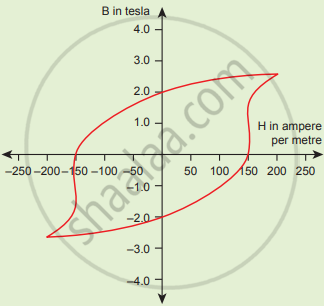
Give the properties of dia/para/ferromagnetic materials.
Assertion: On heating ferromagnetic or ferrimagnetic substances, they become paramagnetic.
Reason: The electrons change their spin on heating.
Which one of the following homo-diatomic molecule is paramagnetic?
Magnetic materials used for making permanent magnets (P) and magnets in a transformer (T) have different properties of the following, which property best matches for the type of magnet required ?
The value of aluminium susceptibility is 2.2 × 10⁻⁵. The percentage increase in the magnetic field if space within a current carrying toroid is filled with aluminium is `"x"/10^4`. Then the value of x is ______.
Which of the following is not paramagnetic?
Which one of the following compounds is diamagnetic and colourless?
