Advertisements
Advertisements
Question
Analysis shows that nickel oxide has the formula Ni0.98O1.00. What fractions of nickel exist as Ni2+ and Ni3+ ions?
Advertisements
Solution
The formula Ni0.98O1.00 indicates that 98 Ni atoms are associated with 100 O atoms. Suppose,
Number of Ni atoms present as Ni2+ = x
∴ Number of Ni atoms present as Ni3+ = 98 − x
Since nickel oxide is electrically neutral, the total charge present on x Ni2+ ions and (98 − x) Ni3+ ions should be equal to the total charge present on 100 O2− ions. Therefore, we have
(x × 2) + (98 − x) × 3 = 100 × 2
or 2x + 294 − 3x = 200
or x = 94
∴ Fraction of Ni present as Ni2+ = `94/98 xx 100`
= 95.9
= 96%
and fraction of Ni present as Ni3+ = `(98 - 94)/98 xx 100`
= 4.08
= 4%
RELATED QUESTIONS
What is ferromagnetism?
What type of magnetism is shown in the following alignment of magnetic moments?

What type of magnetism is shown by a substance if magnetic moments of domains are arranged in same direction?
Write the type of magnetism observed when the magnetic moments are aligned in parallel and anti-parallel directions in unequal numbers.
Explain the following with suitable examples:
Ferrimagnetism
Pyrolusite ore is _______.
Out of [CoF6]3- and [Co(en)3]3+, which one complex is
(i) paramagnetic
(ii) more stable
(iii) inner orbital complex and
(iv) high spin complex
(Atomic no. of Co = 27)
Give reason for the following :
Sulphur in vapour state shows paramagnetic behaviour.
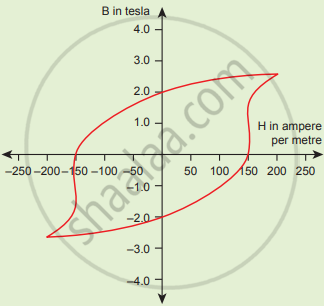
The BH curve for a ferromagnetic material is shown in the figure. The material is placed inside a long solenoid which contains 1000 turns/cm. The current that should be passed in the solenonid to demagnetize the ferromagnet completely is
Compare dia, para and ferromagnetism.
What happens to the domains in a ferromagnetic material in the presence of external magnetic field?
All those atoms or molecules which have an odd number of electrons are
Fe3O4 is ____________.
Which type of substances would make better permanent magnets?
Assertion: On heating ferromagnetic or ferrimagnetic substances, they become paramagnetic.
Reason: The electrons change their spin on heating.
Fe3O4 (magnetite) is an example of ___________.
Which of the following arrangements shows schematic alignment of magnetic moments of antiferromagnetic substances?
Which of the following statements is not true?
A ferromagnetic substance becomes a permanent magnet when it is placed in a magnetic field becuase ______.
Which one of the following homo-diatomic molecule is paramagnetic?
The susceptibility of a paramagnetic material is 99. The permeability of the material in Wb/A-m is ______.
[permeability of the free space μ0 = 4π × 10-7 Wb/A - m]
The value of aluminium susceptibility is 2.2 × 10⁻⁵. The percentage increase in the magnetic field if space within a current carrying toroid is filled with aluminium is `"x"/10^4`. Then the value of x is ______.
Among the following ions, which one has the highest paramagnetism?
Which one of the following compounds is diamagnetic and colourless?
The metal complex ion that is paramagnetic is ______.
(Atomic number of Fe = 26, Cu = 29, Co = 27 and Ni = 28)
