Advertisements
Advertisements
Question
Consider a sunlike star at a distance of 2 parsecs. When it is seen through a telescope with 100 magnification, what should be the angular size of the star? Sun appears to be (1/2)° from the earth. Due to atmospheric fluctuations, eye can’t resolve objects smaller than 1 arc minute.
Advertisements
Solution
The angle of the sun's diameter `(1/2)^circ` is subtended by 1 A.U. since the distance from the sun increases angle subtended in the same ratio.
Now, 2 x 10⁵ A.U. will from an angle of θ = `(1/(4 xx 10^5))^circ`, since the diameter is the same angle subtended on earth by 1 parsec will be same.
If the sunlike star is at 2 parsec the angle becomes half = (1.25 × 10⁻⁶)°
Thus, angle = 75 × 10–6 min
When it is seen with a telescope that has a magnification of 100, the angle formed will be 7.5 × 10⁻³ min, viz., less than a minute.
Hence, it can't be observed by a telescope.
APPEARS IN
RELATED QUESTIONS
The farthest objects in our Universe discovered by modern astronomers are so distant that light emitted by them takes billions of years to reach the Earth. These objects (known as quasars) have many puzzling features, which have not yet been satisfactorily explained. What is the distance in km of a quasar from which light takes 3.0 billion years to reach us?
The nearest star to our solar system is 4.29 light years away. How much is this distance in terms of parsecs? How much parallax would this star (named Alpha Centauri) show when viewed from two locations of the Earth six months apart in its orbit around the Sun?
Just as precise measurements are necessary in science, it is equally important to be able to make rough estimates of quantities using rudimentary ideas and common observations. Think of ways by which you can estimate the following (where an estimate is difficult to obtain, try to get an upper bound on the quantity):
the number of strands of hair on your head
A hand span is a reliable measure of length.
Numerical Problem.
Inian and Ezhilan argue about the light year. Inian tells that it is 9.46 × 10¹⁵ m and Ezhilan argues that it is 9.46 × 10 12 km. Who is right? Justify your answer.
Guess the lengths to draw these things. Ask your friend to draw the same. After you make the drawing use a scale to measure the length. Whose drawing showed a better guess?
| Guess its length and draw |
Measure of your drawing |
Measure of your friend’s drawing |
| An ant of length less than 1 cm |
||
| Pencil of length about 7 cm |
||
| A glass 11 cm high with water up to 5 cm |
||
| A bangle of perimeter 20 cm |
||
| A curly hair of length 16 cm |
Now guess the length and width of many other things. Measure and find the difference between your measure and your guess.
| Size of | Your guess in cm | Your measure in cm | ||
| Length | Width | Length | Width | |
| 100 Rupee note | ||||
| 10 Rupee note | ||||
| 20 Rupee note | ||||
| 5 Rupee note | ||||
| Post card | ||||
| Math-Magic book | ||||
Arbaz plans to tile his kitchen floor with green square tiles. Each side of the tile is 10 cm. His kitchen is 220 cm in length and 180 cm wide. How many tiles will he need?

There are two beautiful lakes near a village. People come for boating and picnics in both the lakes. The village Panchayat is worried that with the noise of the boats the birds will stop coming. The Panchayat wants motorboats in only one lake. The other lake will be saved for the birds to make their nests.
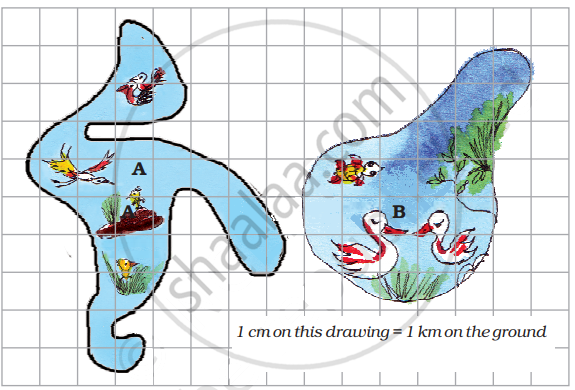
- How many kilometers long is the actual boundary of lake A?
In which SI unit, you can measure your height?
What are the materials needed to find the length of a banana?
What is the unit of measurements of very small lengths?
Length is ______.
The Unit used to measure length ______.
Yard was used as the unit of length.
The SI unit of mass is kg.
According to the modern definition, what fraction of a second does light travel to define one metre?
What is an Astronomical Unit (AU)?
Why is the speed of light used to define the metre?
