Advertisements
Advertisements
प्रश्न
Consider a sunlike star at a distance of 2 parsecs. When it is seen through a telescope with 100 magnification, what should be the angular size of the star? Sun appears to be (1/2)° from the earth. Due to atmospheric fluctuations, eye can’t resolve objects smaller than 1 arc minute.
Advertisements
उत्तर
The angle of the sun's diameter `(1/2)^circ` is subtended by 1 A.U. since the distance from the sun increases angle subtended in the same ratio.
Now, 2 x 10⁵ A.U. will from an angle of θ = `(1/(4 xx 10^5))^circ`, since the diameter is the same angle subtended on earth by 1 parsec will be same.
If the sunlike star is at 2 parsec the angle becomes half = (1.25 × 10⁻⁶)°
Thus, angle = 75 × 10–6 min
When it is seen with a telescope that has a magnification of 100, the angle formed will be 7.5 × 10⁻³ min, viz., less than a minute.
Hence, it can't be observed by a telescope.
APPEARS IN
संबंधित प्रश्न
Just as precise measurements are necessary in science, it is equally important to be able to make rough estimates of quantities using rudimentary ideas and common observations. Think of ways by which you can estimate the following (where an estimate is difficult to obtain, try to get an upper bound on the quantity):
the number of strands of hair on your head
While measuring the length of an object using a ruler, the position of your eye should be
A hand span is a reliable measure of length.
Fill in the following chart.
| Property | Definition | Basic Unit | Instrument used for measuring |
| Length | |||
| Mass | |||
| Volume | |||
| Time |
Find the answer for the following questions within the grid.
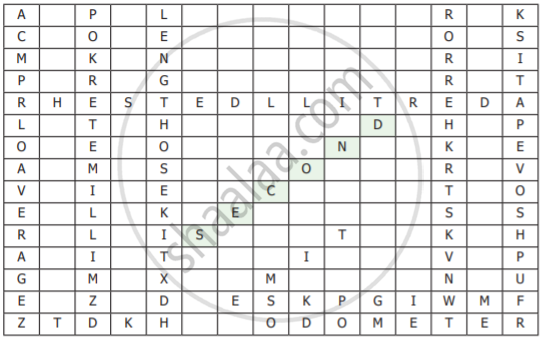
- 10-3 is one ______
- SI Unit of time is ______
- Cross view of reading a measurement leads to ______
- ______ is the one what a clock reads.
- ______ is the amount of substance present in an object.
- ______ can be taken to get the final reading of the recordings of different students for a single measurement.
- ______ is a fundamental quantity.
- ______ shows the distance covered by an automobile
- A tailor uses ______ to take measurements to stitch the cloth.
- Liquids are measured with this physical quantity.
Have you seen frogs? Where? How many different types of frogs have you seen? Are all the frogs of the same length? Here are two interesting examples.

Guess the lengths to draw these things. Ask your friend to draw the same. After you make the drawing use a scale to measure the length. Whose drawing showed a better guess?
| Guess its length and draw |
Measure of your drawing |
Measure of your friend’s drawing |
| An ant of length less than 1 cm |
||
| Pencil of length about 7 cm |
||
| A glass 11 cm high with water up to 5 cm |
||
| A bangle of perimeter 20 cm |
||
| A curly hair of length 16 cm |
What is the length of a 100 rupee note? Guess. Now measure it using a scale.

Now cut strips of equal sizes out of it. Using tape join the strips, end to end, to make a belt.
How long is your belt? _________
There are two beautiful lakes near a village. People come for boating and picnics in both the lakes. The village Panchayat is worried that with the noise of the boats the birds will stop coming. The Panchayat wants motorboats in only one lake. The other lake will be saved for the birds to make their nests.
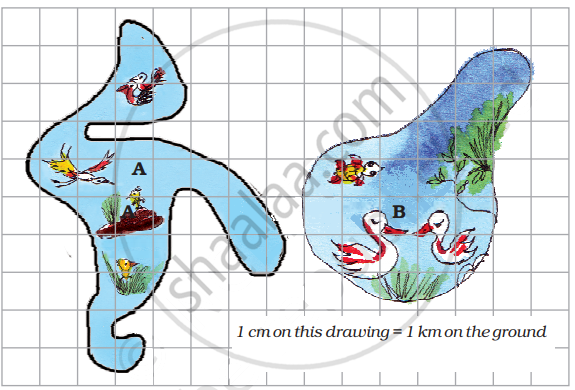
- A longer boundary around the lake will help more birds to lay their eggs. So which lake should be kept for birds? Which lake should be used for boats?
What unit will you use to measure the length of our classroom?
SI unit of electric current is ______.
To measure the distance of a planet from the earth, ______ method is used.
The radius of atom is of the order of 1 Å and the radius of nucleus is of the order of fermi. How many magnitudes higher is the volume of atom as compared to the volume of nucleus?
- The earth-moon distance is about 60 earth radius. What will be the diameter of the earth (approximately in degrees) as seen from the moon?
- Moon is seen to be of (½)°diameter from the earth. What must be the relative size compared to the earth?
- From parallax measurement, the sun is found to be at a distance of about 400 times the earth-moon distance. Estimate the ratio of sun-earth diameters.
The distance of a galaxy is of the order of 1025 m. Calculate the order of magnitude of time taken by light to reach us from the galaxy.
In an experiment to estimate the size of a molecule of oleic acid 1 mL of oleic acid is dissolved in 19 mL of alcohol. Then 1 mL of this solution is diluted to 20 mL by adding alcohol. Now 1 drop of this diluted solution is placed on water in a shallow trough. The solution spreads over the surface of water forming one molecule thick layer. Now, lycopodium powder is sprinkled evenly over the film and its diameter is measured. Knowing the volume of the drop and area of the film we can calculate the thickness of the film which will give us the size of oleic acid molecule.
Read the passage carefully and answer the following questions:
- Why do we dissolve oleic acid in alcohol?
- What is the role of lycopodium powder?
- What would be the volume of oleic acid in each mL of solution prepared?
- How will you calculate the volume of n drops of this solution of oleic acid?
- What will be the volume of oleic acid in one drop of this solution?
How many astronomical units (A.U.) make 1 parsec?
Mars has approximately half of the earth’s diameter. When it is closest to the earth it is at about 1/2 A.U. from the earth. Calculate what size it will appear when seen through the same telescope.
The parallax method is used to measure astronomical distances because ______.
